



Your customer just sent a support request in Portuguese. Your team speaks English. Without multilingual support, that customer walks away frustrated, and likely never comes back. This scenario plays out thousands of times daily for businesses expanding beyond their home markets, and each lost interaction represents more than a single transaction; it signals a gap between your company and the global audience you’re trying to reach.
Multilingual support isn’t just a nice-to-have anymore, it’s a business requirement for any organization serving diverse populations or pursuing international growth. Whether you’re a healthcare provider communicating with non-English-speaking patients, a legal firm handling immigration cases, or an e-commerce company shipping worldwide, the ability to assist customers in their preferred language directly impacts satisfaction, loyalty, and revenue. Studies consistently show that consumers prefer to buy from brands that communicate in their native language, even when they understand English.
At Languages Unlimited, we’ve spent over three decades helping businesses bridge language gaps through professional translation, interpretation, and transcription services. This guide breaks down exactly what multilingual support means, why it matters for your bottom line, and the practical steps you can take to implement it, whether through human expertise, technology solutions, or a combination of both. By the end, you’ll have a clear roadmap for making your business accessible to customers regardless of what language they speak.
What multilingual support covers and what it is not
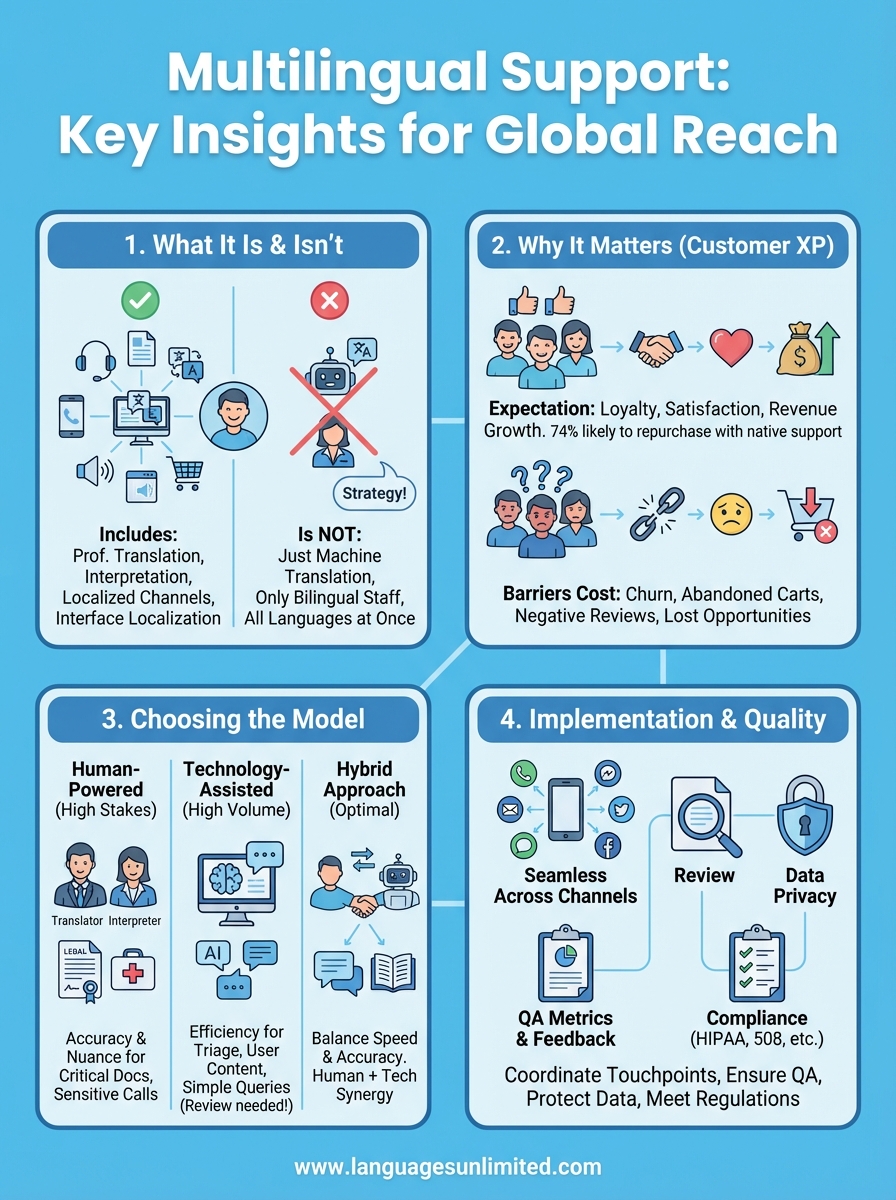
Multilingual support encompasses all the ways your business communicates with customers in languages other than your primary operating language. This includes customer service interactions, product documentation, user interfaces, marketing materials, and transactional communications. When you implement multilingual support, you’re creating pathways for customers to engage with your company without language becoming a barrier to understanding, purchasing, or getting help when they need it.
What multilingual support includes
Professional translation services form the foundation of multilingual support, converting written content like help articles, product descriptions, contracts, and terms of service into other languages while maintaining accuracy and context. Your translated materials need to read naturally in the target language, not like direct word-for-word conversions that confuse readers or miss cultural nuances.
Interpretation services handle real-time spoken communication, whether through phone support, video calls, or in-person interactions. These services ensure customers can speak their native language during sales conversations, technical support calls, or complaints, with trained interpreters facilitating clear two-way communication between your team and the customer. Video remote interpreting and telephonic interpretation let you offer this support without geographic limitations.
Localized customer support channels extend beyond just translating content to adapting your entire support experience for different markets. This means offering chat support in multiple languages, maintaining region-specific help centers, and ensuring your team can route inquiries to language-appropriate agents or interpreters quickly. You also need to consider time zones, local holidays, and communication preferences that vary by culture when structuring your support operations.
Interface localization makes your digital products accessible by translating every element customers interact with, from navigation menus to error messages to checkout flows. Software applications, websites, and mobile apps all require careful localization that goes beyond text to include appropriate date formats, currency displays, measurement units, and culturally relevant imagery.
Multilingual support succeeds when customers can complete their entire journey in their preferred language, from discovery to purchase to post-sale support.
What multilingual support is not
Multilingual support does not mean running everything through automated translation tools and calling it done. Machine translation creates a starting point, but it produces errors, misses context, and often generates awkward phrasing that damages your credibility. Relying solely on automated systems without human review leaves customers confused and frustrated when translations don’t make sense or convey incorrect information.
Hiring bilingual staff members and expecting them to handle all translation needs isn’t true multilingual support either. Your Spanish-speaking customer service representative likely isn’t qualified to translate legal contracts, medical records, or technical documentation. Professional translation requires specific training in terminology, cultural adaptation, and quality assurance processes that go far beyond conversational fluency. Similarly, asking team members to interpret during high-stakes situations like medical consultations or legal proceedings without proper certification puts both your business and customers at risk.
Multilingual support also doesn’t mean offering support in every language that exists. You need to strategically select languages based on your customer demographics, market priorities, and resource capacity. Starting with the languages that represent your largest customer segments or most valuable growth opportunities makes practical sense. A company serving primarily Spanish and Chinese-speaking customers shouldn’t stretch resources thin trying to support fifty languages poorly when excellent support in three languages delivers better results.
Finally, multilingual support isn’t a one-time project you complete and forget. Languages evolve, your product offerings change, new markets emerge, and customer expectations shift. Maintaining multilingual support requires ongoing investment in updating translations, training staff, refining processes, and monitoring quality across all supported languages.
Why multilingual support matters for customer experience
When customers can’t understand your support materials or communicate their problems effectively, they abandon your brand for competitors who speak their language. Customer experience fundamentally depends on clear communication, and language barriers create friction at every interaction point. Research shows that 74% of consumers are more likely to repurchase from brands that provide post-sale support in their native language, which directly connects language accessibility to customer retention and lifetime value.
Customers expect communication in their language
Your customers expect you to meet them where they are, not force them to adapt to your preferred language. When someone visits your website, downloads your app, or contacts support, they want immediate access to information in the language they think and make decisions in. This expectation intensifies for complex purchases, technical troubleshooting, or situations involving contracts and commitments where understanding every detail matters for their confidence.
The consequences of failing to meet this expectation show up quickly in your metrics. Customers who encounter language barriers during support interactions have significantly higher churn rates than those who receive help in their preferred language. They also generate more repeat contacts because initial problems don’t get resolved properly, creating inefficiency in your support operations while simultaneously damaging customer satisfaction scores.
Providing multilingual support signals to customers that you value their business enough to invest in accessible communication.
Language barriers cost you revenue
Every customer who abandons a purchase because they can’t understand product details or terms of service represents lost revenue that compounds over time. Cart abandonment rates increase substantially when checkout processes, shipping information, or return policies appear only in unfamiliar languages. You also lose opportunities to upsell or cross-sell when customers can’t clearly understand the value of additional products or services you offer.
Beyond direct sales losses, language barriers damage your reputation in international markets and multicultural communities. Negative reviews citing poor communication or lack of language support discourage other potential customers who speak the same language from trying your product. Word-of-mouth recommendations, which drive significant customer acquisition, disappear when people feel excluded by language limitations.
How to choose the right multilingual support model
Your multilingual support model needs to match your business requirements, budget constraints, and quality standards. Choosing the wrong approach creates either unsustainable costs or poor customer experiences that damage your reputation. The right model balances accessibility, accuracy, and efficiency based on your specific customer interactions and the stakes involved in miscommunication.

Human-powered professional services
Professional human translation and interpretation deliver the highest accuracy and cultural sensitivity for situations where mistakes carry serious consequences. Legal documents, medical communications, financial disclosures, and contractual agreements require certified translators and interpreters who understand specialized terminology and compliance requirements. Your business also benefits from human expertise when handling emotionally charged customer interactions, complex technical support cases, or communications that require cultural adaptation beyond literal translation.
You’ll pay premium rates for professional services, but the cost of errors in high-stakes situations far exceeds the investment in expert linguists. Consider using professional services for customer-facing materials that define your brand, legal obligations, or product safety information. Languages Unlimited maintains a network of over ten thousand translators and interpreters who specialize in different industries and language pairs, giving you access to appropriate expertise without maintaining full-time staff for every language you support.
Technology-assisted models
Machine translation tools and AI-powered multilingual support platforms handle high-volume, low-risk communications efficiently. Automated translation works well for internal documentation, user-generated content moderation, and initial triage of customer inquiries where perfect accuracy matters less than speed and cost efficiency. These tools continuously improve but still struggle with idiomatic expressions, context-dependent meanings, and specialized vocabulary.
Technology solutions make economic sense when you need real-time translation for chat support, instant translation of product reviews, or automated responses to common questions. Implement quality controls that flag automated translations for human review when conversations involve complaints, technical problems, or purchase decisions. Never rely on unreviewed machine translation for anything legally binding or safety-critical.
The most effective multilingual support strategies combine human expertise for critical communications with technology for scale and speed.
Hybrid approaches
Most businesses achieve optimal results by strategically deploying both professional human services and technology solutions based on each interaction’s importance and complexity. You might use AI translation for first-level support triage, then seamlessly transfer customers to professional interpreters when issues escalate or require detailed explanation. Similarly, you could machine-translate help articles for initial publication, then have professional linguists review and refine them based on customer feedback and usage patterns.
How to implement multilingual support across channels
Implementing multilingual support requires a coordinated approach across every customer touchpoint, from initial contact through resolution. You can’t simply translate your website and expect customers to find answers; you need consistent language accessibility across phone support, email, chat, social media, help centers, and in-app messaging. Each channel presents different technical and operational challenges that require specific solutions, and customers expect seamless transitions when moving between channels during a single support interaction.
Starting with your core support channels
Your implementation should prioritize the channels where customers most frequently seek help. Phone and email support typically handle the majority of inquiries for most businesses, making them logical starting points for multilingual capabilities. For phone support, establish relationships with professional interpretation services that provide on-demand access to interpreters across your needed languages. Telephonic interpretation connects your English-speaking agents with interpreters in seconds, allowing customers to speak their native language while your team continues working normally.
Email support requires translated response templates and access to professional translators for complex inquiries that fall outside standard responses. Build a library of common responses in each supported language, covering frequent questions about shipping, returns, account management, and basic troubleshooting. When customers send inquiries in languages your team doesn’t speak, route those messages to translation services that can provide accurate responses within your target response time. Languages Unlimited offers transcription and translation services that help businesses maintain quick turnaround times without sacrificing quality.
Your customers shouldn’t need to repeat their problem when switching from chat to phone or email to in-person support.
Expanding to digital touchpoints
Digital channels like live chat, help centers, and social media demand real-time or near-real-time multilingual support that scales efficiently. Implement chat systems that detect customer language preferences automatically and route conversations to agents who speak those languages or provide access to instant interpretation. Your chat interface should let customers select their preferred language upfront, avoiding frustration when they start conversations in one language only to receive responses in another.
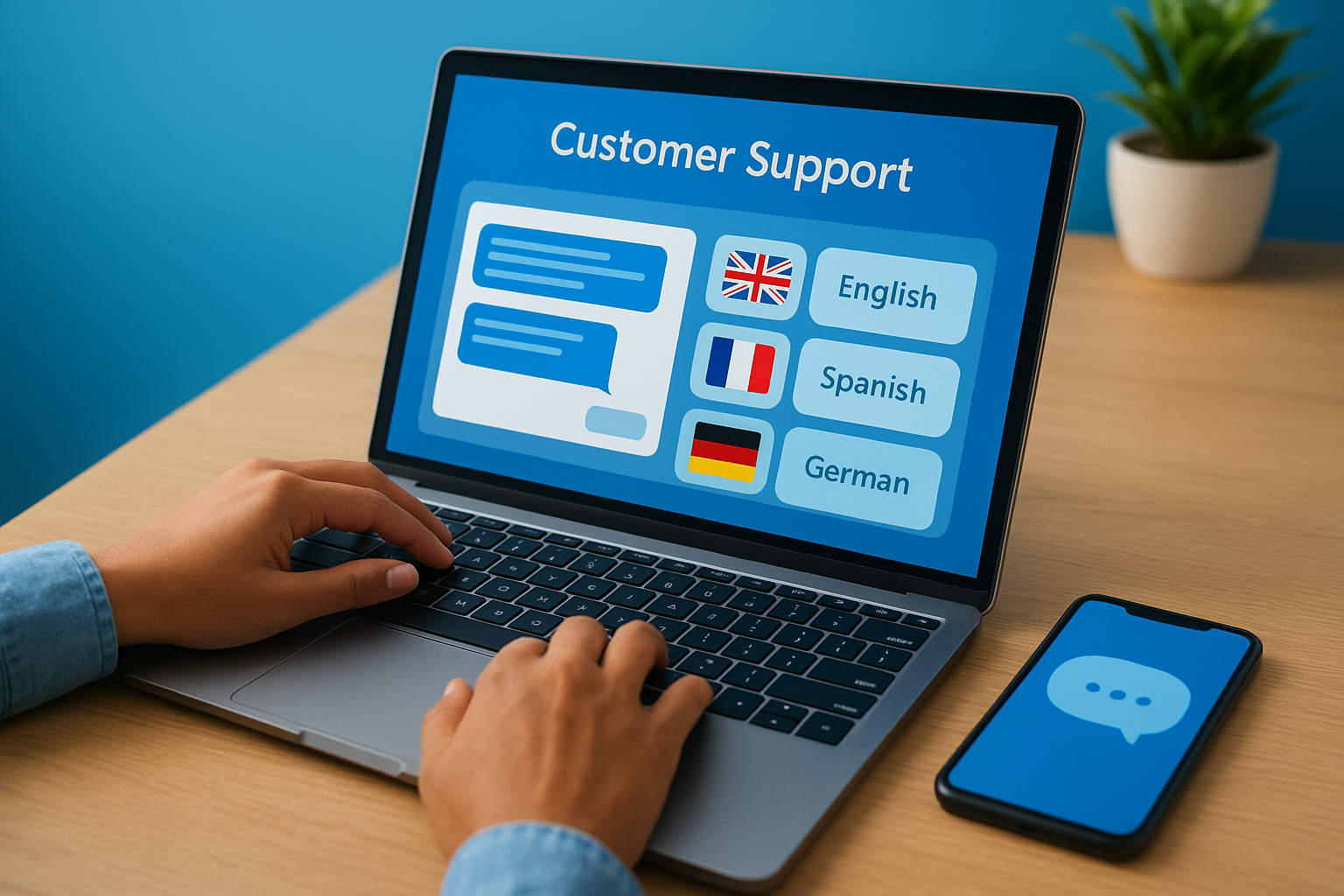
Help centers require comprehensive translation of your knowledge base articles, FAQs, and video tutorials. Start by translating your most-viewed content and articles that resolve common problems, then expand coverage based on customer usage patterns. Keep translated content synchronized with your primary language version, updating all language variants whenever you modify original articles to prevent customers from receiving outdated information.
How to ensure quality, privacy, and compliance
Quality control, data protection, and regulatory compliance create the foundation for trustworthy multilingual support that protects both your business and your customers. Poor translation quality damages your reputation and confuses customers, while data breaches or compliance failures expose you to lawsuits, fines, and loss of customer trust. You need systematic approaches to maintain high standards across all languages and protect sensitive information that flows through your multilingual support channels.
Quality assurance processes
Your quality assurance system should include multiple checkpoints that catch errors before customers see them. Implement review workflows where a second linguist checks all translations before publication, especially for customer-facing content like product descriptions, support articles, and legal documents. This peer review process identifies mistranslations, cultural missteps, and terminology inconsistencies that a single translator might miss.
Track quality metrics like customer satisfaction scores, first-contact resolution rates, and escalation frequency across each language you support. These metrics reveal when translation quality falls short or when interpreters need additional training. Your business should also collect feedback from customers about language support experiences and review actual support transcripts to identify patterns of confusion or miscommunication.
Regular quality audits of your multilingual support materials prevent small errors from becoming systemic problems that undermine customer confidence.
Privacy and data security
Customer data that passes through translation and interpretation services requires the same protection as information handled by your internal team. Verify that any language service provider you work with maintains appropriate security certifications and follows data protection protocols that match your industry requirements. Your contracts with translation services must include clear confidentiality agreements and specify how customer information gets handled, stored, and eventually deleted.
Sensitive information like medical records, financial details, and personal identification documents demands extra precautions during translation. Use secure file transfer systems rather than email for transmitting documents, and ensure translators and interpreters sign non-disclosure agreements before accessing customer information. Professional services like those from Languages Unlimited typically maintain established security protocols that meet healthcare HIPAA requirements and other industry standards.
Regulatory compliance requirements
Different industries and regions impose specific requirements for multilingual support that you must follow to operate legally. Healthcare providers need HIPAA-compliant interpreters, while government contractors require Section 508 accessibility compliance for all communications. Financial services face regulations about providing disclosures in customers’ native languages, and immigration-related translations often require USCIS approval and certified translators.
Research the regulatory requirements specific to your industry and the markets you serve before implementing multilingual support. Your language service providers should demonstrate relevant certifications and experience meeting these requirements, reducing your compliance risk.
Next steps
Your multilingual support strategy starts with understanding which languages your customers speak and which communication channels they use most frequently. Audit your current customer interactions to identify language gaps that cost you revenue or create frustration. Look at support ticket data, abandoned cart analytics, and customer feedback to prioritize which languages deserve immediate attention versus those you can add later as you scale.
Partner with experienced language service providers who understand your industry’s requirements and can deliver consistent quality across translation, interpretation, and transcription needs. Professional services prevent the costly mistakes that damage customer relationships and expose you to compliance risks. Building these relationships now positions you to expand quickly when new market opportunities emerge.
Languages Unlimited has helped businesses implement effective multilingual support for over thirty years across legal, medical, government, and commercial sectors. Our network of certified translators and interpreters ensures you get expert support in the languages your customers speak. Contact our team to discuss your specific multilingual support requirements and get a customized implementation plan.