



If you’ve ever searched for legal document translation rates, you’ve probably noticed that getting a straight answer isn’t easy. Some providers quote per word, others quote per page, and many won’t share pricing at all until you submit your documents. That lack of transparency makes it difficult to budget, especially when you’re dealing with contracts, immigration filings, court documents, or compliance materials where certified accuracy isn’t optional.
Rates depend on several factors: the language pair, the complexity of the legal terminology, turnaround time, and whether certification or notarization is required. A straightforward birth certificate translation for USCIS won’t cost the same as a multi-jurisdictional contract translated into Mandarin. Understanding how providers structure their pricing helps you compare quotes fairly and avoid surprises on your invoice. It also helps you recognize when a quote is suspiciously low, a real risk when legal consequences are on the line.
At Languages Unlimited, we’ve provided certified legal translation services since 1994, working with law firms, government agencies, courts, and individuals across all 50 states. As an ATA member, USCIS-approved, and GSA contract holder, we know this space well. This article breaks down current per-word and per-page cost ranges, explains what drives pricing differences, and gives you the context you need to make an informed decision, whether you choose us or another qualified provider.
What legal translation rates mean
Legal document translation rates refer to the pricing structure a provider uses to charge for converting legal text from one language into another with the accuracy and documentation that legal use requires. Unlike general translation, legal translation carries professional and legal accountability since a mistranslation in a contract clause, immigration filing, or court document can have serious consequences. Rates reflect not just the time spent converting words, but also the specialized expertise, multi-step quality control, and credentialing that legitimate legal translation demands. When you see a wide spread in pricing across providers, that spread usually signals real differences in qualifications, not just margin.
Legal translation rates are not simply a fee for word conversion; they represent the expertise and accountability that legal contexts require.
How providers bill for translation work
Translation providers use two primary billing models: per-word pricing and per-page pricing. Per-word pricing is more common among professional agencies and qualified freelancers because it scales directly with the volume of source text, meaning you pay proportionally for exactly what needs to be translated. Per-page pricing is simpler to quote upfront but can vary widely depending on how a provider defines a "page," which typically falls between 250 and 300 words for standard legal documents.
Some providers also charge flat fees for predictable document types, such as birth certificates, marriage licenses, or driver’s licenses, where the word count and terminology are consistent. Understanding which billing model a provider uses helps you compare quotes on equal footing. A per-page rate that looks high may actually be competitive once you calculate its equivalent per-word cost, while a per-word rate that looks low may not include formatting, certification, or revision rounds that other providers bundle in.
What "certified" adds to the cost
Certified translation means the translator or agency provides a signed statement of accuracy confirming that the translation is a complete and faithful representation of the original document. This is a firm requirement for USCIS immigration filings, many federal and state courts, academic institutions, and licensing boards. Certification is not the same as notarization, though some use cases require both.
The certification component typically adds a flat fee on top of the base translation rate. Some providers bundle it into their per-word or per-page pricing; others list it as a separate line item. When you collect quotes, always confirm whether certification is included in the stated rate, because a lower headline price without certification can end up costing more after that fee is added. Notarization, which involves a licensed notary verifying the translator’s identity and signature, adds another cost layer but is required less frequently than certification alone. Knowing what each component covers lets you evaluate legal document translation rates on actual, comparable terms.
Typical per-word and per-page price ranges
Knowing actual numbers lets you spot outliers and set a realistic budget before you contact any provider. For legal document translation rates, the market has fairly consistent ranges, though certified work and specialty language pairs push those numbers upward. The figures below reflect current professional rates for qualified, credentialed providers in the United States.
Per-word pricing
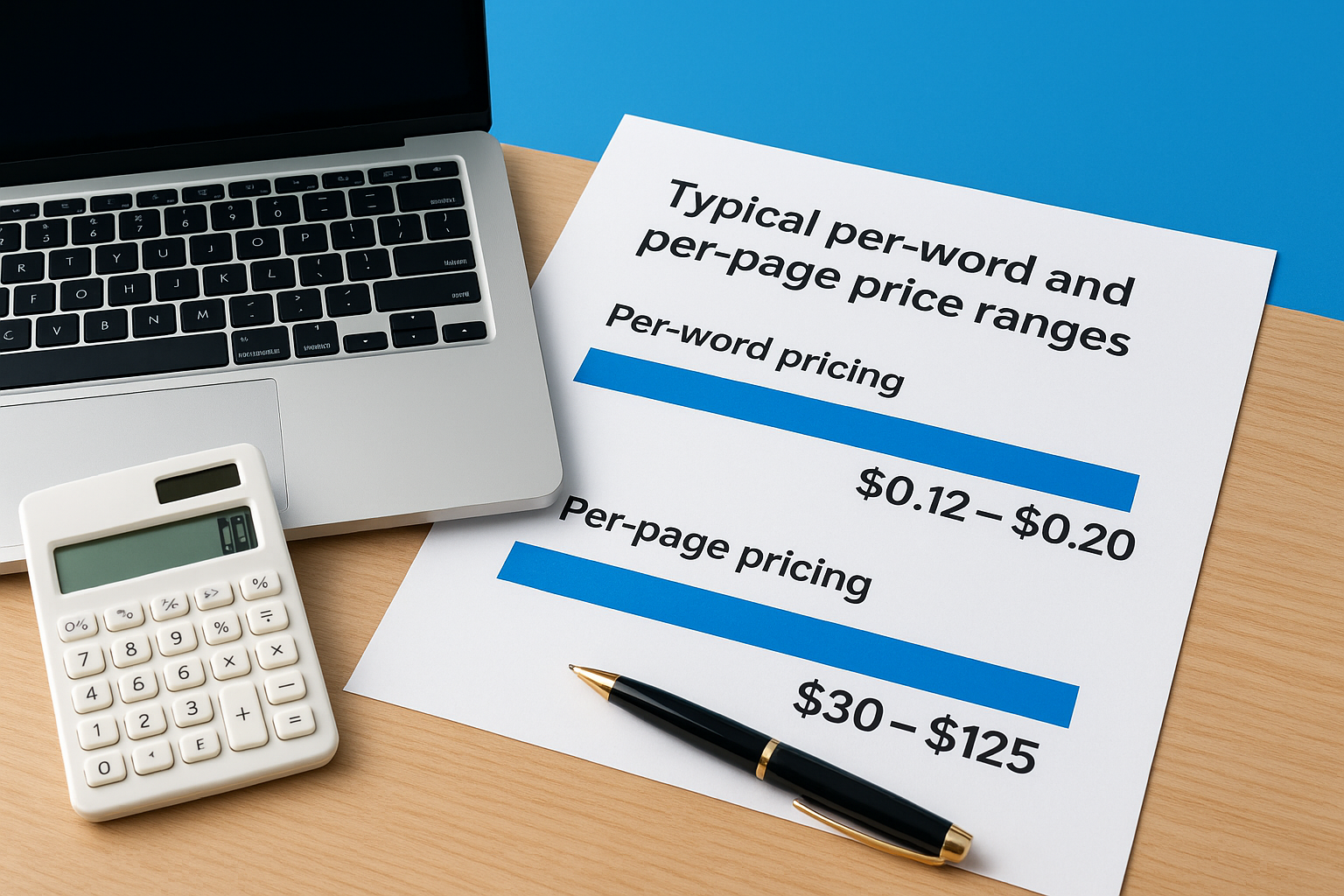
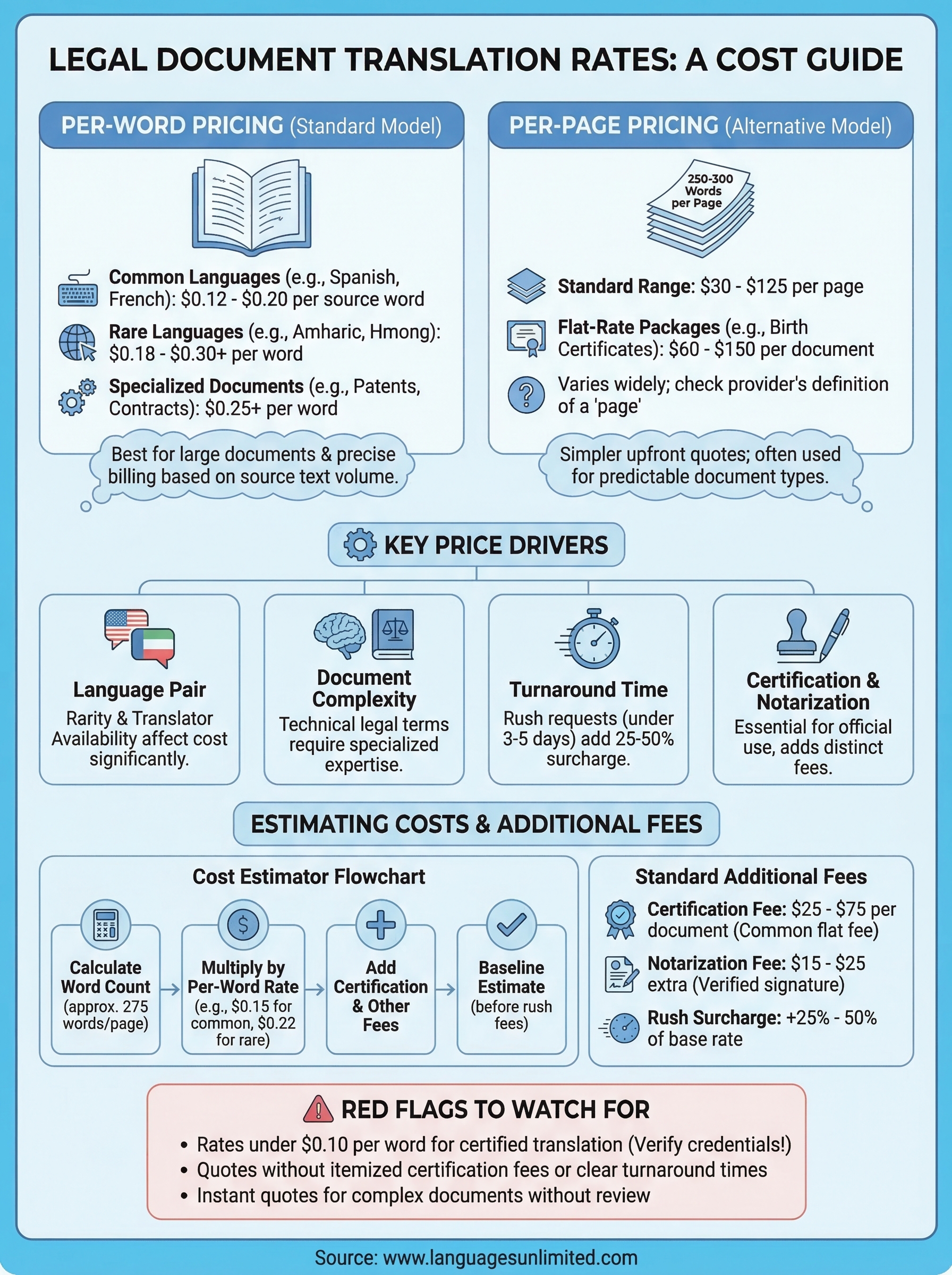
Professional legal translation into or out of common language pairs (Spanish, French, German, Portuguese) typically runs between $0.12 and $0.20 per source word. Less common languages such as Amharic, Hmong, or Haitian Creole often fall between $0.18 and $0.30 per word, sometimes higher for rare dialects with limited qualified translators. Highly specialized document types, including arbitration agreements, patent filings, or multi-party contracts, can push rates above $0.25 per word even for common language pairs due to the terminology depth required.
If a quote comes in under $0.10 per word for certified legal translation, verify the provider’s credentials before moving forward.
Certification adds a flat fee on top of the base per-word rate. That fee commonly runs $25 to $75 per document, depending on the provider and whether notarization is also included in your requirements.
Per-page pricing
Per-page rates for legal documents typically range from $30 to $125 per page, with a standard page defined as roughly 250 to 300 words. Certified translations of straightforward personal documents, such as birth certificates or marriage licenses, usually fall at the lower end of that range. Complex legal instruments, including property deeds, court transcripts, or multilateral agreements, sit toward the higher end because they demand more expertise and review time.
Some providers offer flat-rate packages for predictable document types where word count and formatting stay consistent. These packages typically include certification and range from $60 to $150 per document. Flat rates simplify your budgeting, but they work best when your document matches a standard template; atypical formats may still require a custom quote to price accurately.
What drives the price up or down
Several factors shift legal document translation rates significantly, and understanding them helps you anticipate costs before requesting a quote. Providers don’t set prices arbitrarily; they price based on real variables that affect how long the work takes and what qualifications it demands. Knowing which levers affect your specific project lets you have a more productive conversation with any provider you contact.
Language pair and translator availability
The language pair you need is often the single biggest cost driver. Spanish, French, and Portuguese translations cost less because there are more qualified legal translators working in those languages, which keeps supply and demand balanced. Rare language pairs such as Tigrinya, Khmer, or Somali command higher rates because fewer credentialed translators specialize in legal terminology for those languages, and the ones who do can charge accordingly for their scarcity.
If your document requires a rare language pair, build extra lead time into your project so you’re not also paying rush fees on top of the premium rate.
Document complexity and subject matter
A standard personal document, like a birth certificate or marriage license, uses predictable formatting and limited terminology, which keeps translation time and cost lower. Contrast that with a multi-clause commercial agreement or litigation transcript, where a translator must navigate technical legal terms, cross-jurisdictional references, and nuanced contractual language that requires deeper subject matter expertise. Some documents also require two-step review processes where a second qualified translator checks the first pass, adding time and cost but delivering higher accuracy for high-stakes filings.
Turnaround time and volume
Rush timelines increase costs across the board. A standard turnaround of three to five business days is factored into most baseline quotes; anything faster typically triggers a surcharge of 25 to 50 percent. On the other end, larger projects or ongoing contracts often qualify for volume pricing because the administrative overhead per word decreases at scale. If you have multiple documents to translate, submitting them together or establishing a service agreement can reduce your per-word cost compared to one-off orders.
How to estimate costs for your documents
Before you contact any provider, you can build a reasonable cost estimate on your own using a few straightforward inputs. Having a number in mind before you request quotes gives you a baseline for comparison and prevents sticker shock when invoices arrive. The process doesn’t require any special tools, just an understanding of how legal document translation rates are structured.
Calculate your word count first
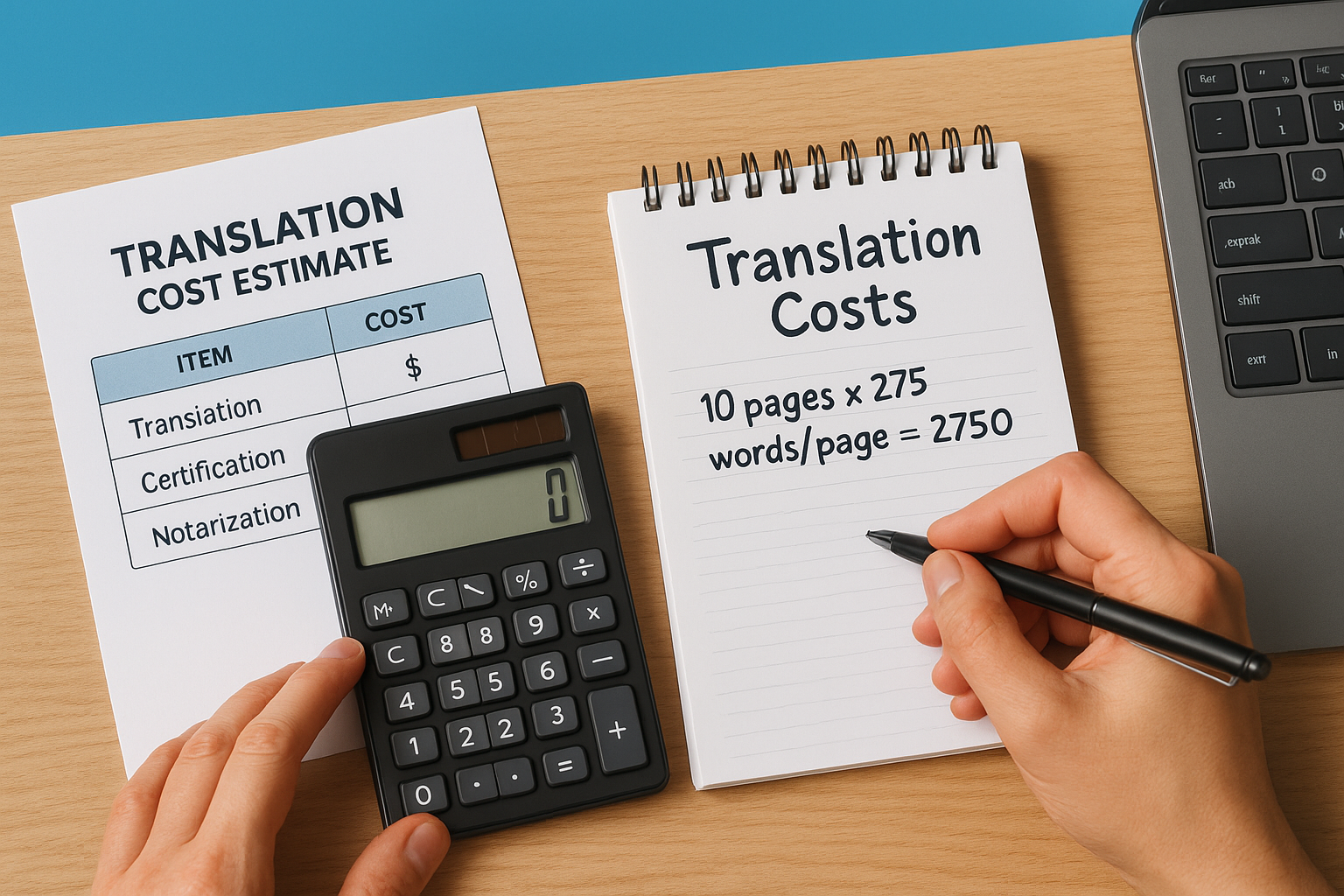
Open your document and run a word count using whatever software you used to create it. If the document is a scanned image or paper original, a standard legal page runs approximately 250 to 300 words, so multiply your page count by 275 as a reliable midpoint. Once you have your source word count, multiply it by your expected per-word rate. For common language pairs, use $0.15 as a mid-range estimate; for rare languages, use $0.22 or higher to avoid underestimating.
For a 10-page contract at 275 words per page, a mid-range estimate for Spanish translation would be roughly $412 at $0.15 per word, before certification or rush fees.
For flat-rate document types like birth certificates or marriage licenses, skip the word count step entirely and plan for $60 to $150 per document as your working estimate, depending on whether notarization is also required.
Factor in certification and turnaround
Add $25 to $75 per document for certification on top of your base translation estimate. If you need notarization as well, budget an additional $15 to $25 depending on your state. These are predictable add-ons that most providers charge separately, so keeping them as distinct line items in your estimate prevents you from comparing an all-in quote against a base-only quote and drawing the wrong conclusion.
Turnaround time is the last variable to account for. If your timeline is tighter than three business days, apply a 25 to 50 percent surcharge to your base estimate. Building this into your projection before you reach out puts you in a much stronger position to evaluate every quote you receive.
How to compare providers and request quotes
When you’ve built your estimate and know your document type, you’re ready to compare providers. The key is to request quotes in a way that forces apples-to-apples comparisons, because legal document translation rates are easy to misread when providers structure their pricing differently. Ask each provider the same set of questions and request a fully itemized breakdown rather than a single total number.
What to ask before you submit documents
Before sending your documents to any provider, ask three direct questions: Does the quoted rate include certification? What is the standard turnaround time at that rate? And does the provider hold verified credentials such as ATA membership, USCIS approval, or documented subject matter experience with your specific document type? These questions surface the real cost and qualify the provider in one step, saving you time chasing incomplete quotes.
You should also confirm how the provider handles revisions and quality review. A reputable agency will have a defined process for catching errors before delivery, often including a second-translator review for complex legal documents. If a provider cannot describe their review process, that gap is worth factoring into your decision alongside the price.
Credentials and process matter as much as price; a low quote from an unqualified provider can cost far more to fix than a correct translation done right the first time.
Red flags to watch for in quotes
Watch for quotes that omit certification fees or use vague language like "starting from" without a clear ceiling. These structures make it difficult to confirm your final cost until after the work is done, which puts you in a weak negotiating position. A trustworthy provider gives you a complete, itemized breakdown before you commit.
Also be cautious when a quote arrives within minutes of submission without any questions about the document. Professional legal translation requires the translator to review source material before pricing, especially for complex or multi-page documents. A quote that skips that step usually skips the quality review too.
Next steps
Now that you understand how legal document translation rates work, you have everything you need to budget accurately and evaluate providers without getting misled by incomplete quotes. You know the typical per-word and per-page ranges, what certification and notarization add to your total, and which red flags to watch for when comparing quotes. That knowledge puts you in a much stronger position than most clients who reach out to providers without any frame of reference.
Your next move is straightforward: gather your documents, run a quick word count, and build your baseline estimate using the ranges covered in this article. From there, request fully itemized quotes from qualified providers and compare them on equal terms. If you want to skip the back-and-forth and work with a certified, USCIS-approved agency with over 30 years of legal translation experience, contact Languages Unlimited for a quote and get a clear answer fast.