



When a parent company operates foreign subsidiaries, those entities keep their books in local currencies. Before any consolidated reporting can happen, someone needs to know how to translate financial statements from the subsidiary’s functional currency into the parent’s reporting currency. Get this wrong, and you’re looking at misstated earnings, compliance failures, and unreliable financial data that erodes stakeholder trust.
The process involves selecting the right translation method, current rate or temporal, applying the correct exchange rates to different line items, and properly handling the translation adjustments that result. Standards like ASC 830 and IAS 21 govern how this works, but the practical steps can feel unclear if you haven’t walked through them before. This guide breaks down each stage of the translation process so you can apply it with confidence.
At Languages Unlimited, we work with multinational corporations, legal teams, and financial institutions that need accurate linguistic translation of financial documents across 200+ languages, from audited statements to regulatory filings. We understand that foreign currency reporting and multilingual financial communication go hand in hand for global organizations. Below, you’ll find a step-by-step walkthrough of the accounting side of financial statement translation, from identifying functional currencies to recording cumulative translation adjustments.
What financial statement translation means in FX
In FX reporting, financial statement translation refers to the accounting process of converting a foreign subsidiary’s financial statements from its functional currency into the parent company’s reporting currency. This is an accounting exercise governed by standards like ASC 830 (US GAAP) or IAS 21 (IFRS), not a word-for-word language translation. The numbers in the statements change to reflect the exchange rates in effect at different points in time, and the result feeds directly into your consolidated financial reports.
Accounting translation vs. linguistic translation
Understanding how to translate financial statements means recognizing that two separate disciplines carry the same name. Accounting translation converts monetary values using exchange rates, while linguistic translation converts the actual text of financial documents into another language for regulatory submissions, audits, or cross-border legal requirements. A German subsidiary’s balance sheet might need both: the numbers re-stated in USD for consolidation, and the document text itself translated into English for an SEC filing or bank covenant review.
Many multinational organizations handle the accounting conversion internally but overlook the need for certified linguistic translation when submitting documents to regulators, courts, or foreign counterparties.
Both forms of translation carry real compliance risk. Errors in either process can trigger restatements, audit findings, or rejected filings. If your organization operates in multiple countries and needs the actual document text translated, that is a separate requirement from the exchange rate conversion this guide covers.
How exchange rates drive the complexity
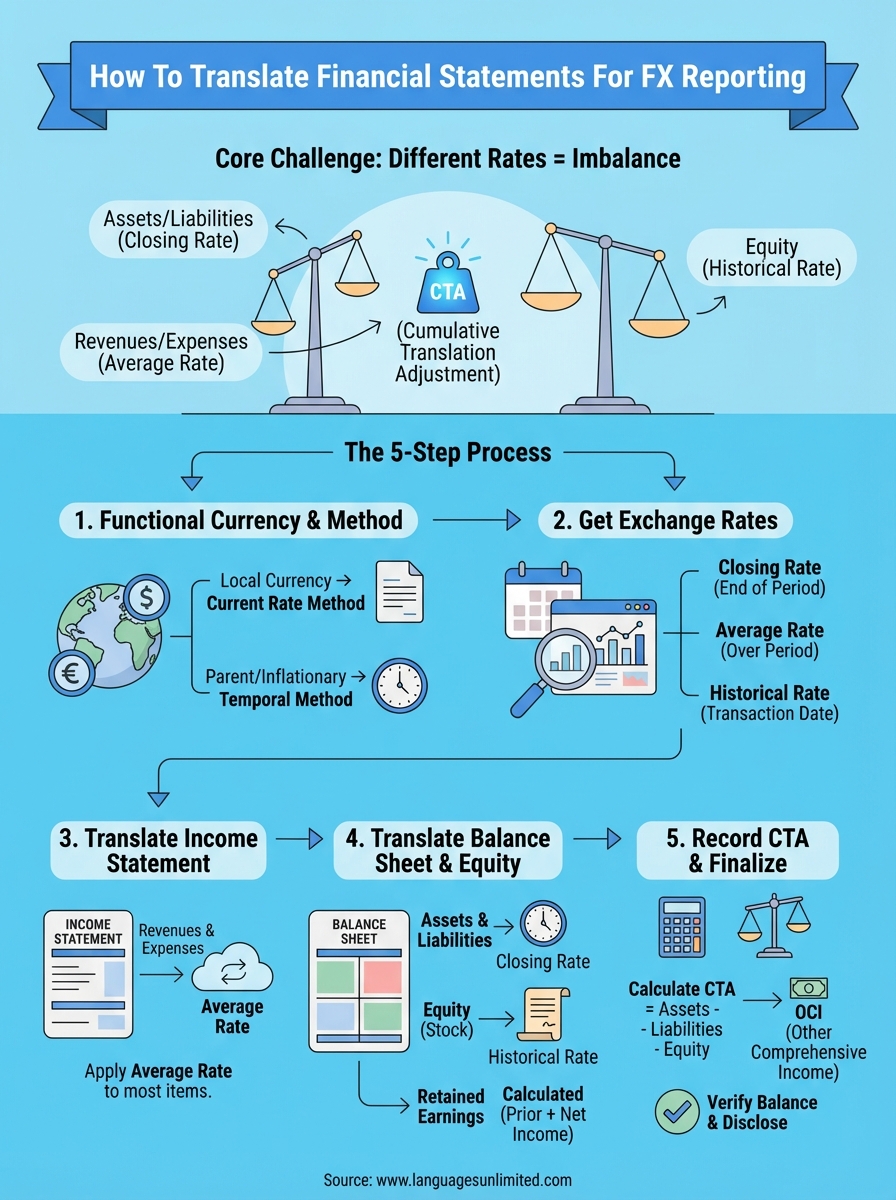
The core challenge in FX translation is that not all line items use the same exchange rate. Assets and liabilities on the balance sheet typically use the rate at the reporting date (the current rate), while revenues and expenses on the income statement use the average rate for the period. Equity accounts, however, use historical rates from when the transactions originally occurred.
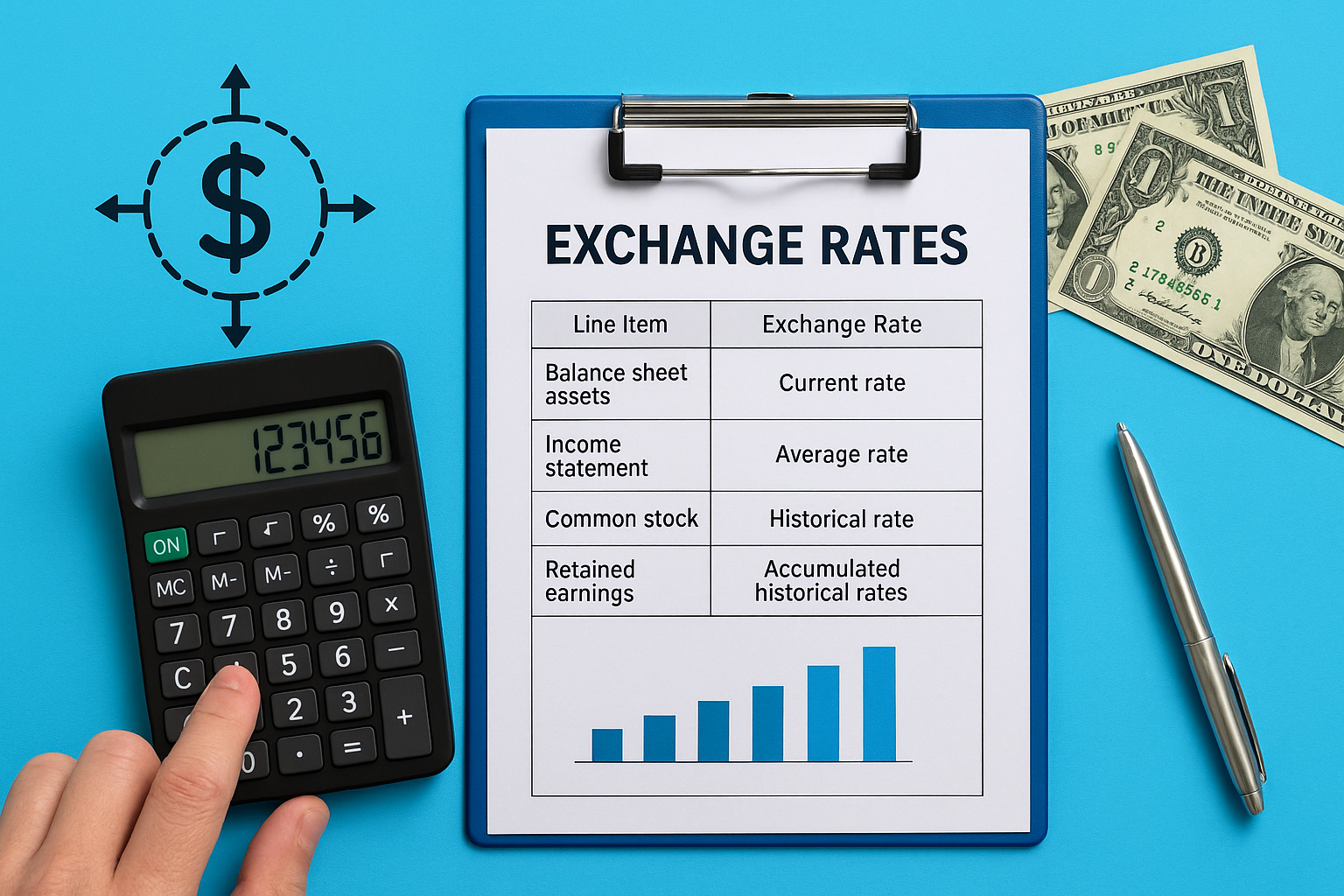
Here is how different line items map to exchange rates:
| Line Item | Exchange Rate Used |
|---|---|
| Balance sheet assets and liabilities | Current rate (closing rate at period end) |
| Income statement revenues and expenses | Average rate for the reporting period |
| Common stock and paid-in capital | Historical rate at issuance date |
| Retained earnings | Accumulated historical rates |
Because these rates differ, the translated totals will not naturally balance. The gap that results is called the cumulative translation adjustment (CTA), which gets recorded in other comprehensive income (OCI) on the balance sheet. Understanding this mechanism upfront prevents confusion when you reach the final reconciliation step.
Why the functional currency determination matters most
Before you apply any exchange rates, you need to confirm the subsidiary’s functional currency, which is the primary economic currency of the environment in which it operates. This single determination decides which translation method you use. If the functional currency differs from the parent’s reporting currency, you apply the current rate method under ASC 830 or IAS 21. If the subsidiary operates in a highly inflationary environment or its records are kept in a currency that is not its functional currency, you apply the temporal method instead.
Getting the functional currency wrong means every exchange rate you apply afterward is also wrong. The Financial Accounting Standards Board (FASB) provides guidance on indicators to evaluate, including where the subsidiary generates and spends cash, where it prices its products, and where it sources its financing arrangements. Locking down this determination before you touch a single line item is the most important decision in the entire translation process.
Step 1. Confirm functional currency and method
Before you apply a single exchange rate, you need to lock down the functional currency of each subsidiary you are translating. This determination drives every number that follows in the process, so rushing through it creates compounding errors across your entire consolidated report. Part of knowing how to translate financial statements correctly is recognizing that this step is not administrative; it is the technical foundation the rest of your translation rests on.
How to identify the functional currency
ASC 830 and IAS 21 both direct you to evaluate a set of indicators that point to the primary economic environment the subsidiary operates in. No single indicator is automatically decisive; you weigh them together. Work through the following factors for each subsidiary:
- Primary cash flows: Does the subsidiary generate and use cash mainly in one currency?
- Sales prices: Are the subsidiary’s prices set locally or driven by international competition in another currency?
- Sales markets: Does the subsidiary sell primarily in the country where it is based?
- Expenses: Are labor, materials, and operating costs denominated in the local currency?
- Financing: Does the subsidiary raise debt and equity in the local currency?
- Intercompany transactions: Are significant transactions with the parent denominated in the parent’s currency?
If most indicators point to the local currency, that is the functional currency. If indicators consistently point to the parent’s currency, the parent’s reporting currency likely serves as the functional currency for that subsidiary instead.
Document your functional currency determination in writing each reporting period; auditors will ask for it, and it protects you if the assessment is ever challenged.
Selecting the right translation method
Once you confirm the functional currency, the translation method follows directly from that conclusion. Use this decision rule:
| Scenario | Method to Use |
|---|---|
| Functional currency differs from reporting currency | Current rate method |
| Functional currency equals the reporting currency | Remeasurement (temporal method) |
| Subsidiary in a highly inflationary economy | Temporal method regardless of functional currency |
Your choice here reshapes how you handle every balance sheet and income statement line item. When you apply the current rate method, most items translate at either the closing or average rate. When you apply the temporal method, non-monetary items such as inventory and fixed assets translate at historical rates, which adds significant complexity to the process. Confirm this selection before you open any spreadsheet.
Step 2. Get the right exchange rates and data
Once you have confirmed the functional currency and selected your translation method, your next job is to gather the specific exchange rates you will apply to each category of line items. This step is where the mechanics of how to translate financial statements become very concrete. You need three distinct rate types: the closing rate at period end, the average rate for the reporting period, and historical rates for equity transactions. Pulling inaccurate or mismatched rates here will distort every translated figure downstream.
Use rates sourced from a single, consistent provider throughout each reporting period; mixing rate sources between line items creates unexplainable variances at the reconciliation stage.
Where to source reliable exchange rates
You need to pull rates from authoritative, auditable sources that your auditors will accept without objection. The most commonly accepted sources for US GAAP and IFRS reporting purposes include central bank publications, the US Federal Reserve’s foreign exchange data releases, and the European Central Bank for EUR-related translations. Your rate provider should offer historical daily rates so you can extract both the closing rate at your specific period-end date and an accurate average for the period.
Here is a quick reference for which rate type to pull:
| Rate Type | How to Calculate or Source It |
|---|---|
| Closing rate | Spot rate on the last day of the reporting period |
| Average rate | Simple or weighted average of daily rates across the period |
| Historical rate | Spot rate on the original transaction date |
Organizing your rate data before you translate
Before you open your translation workbook, build a rates reference tab that stores each rate type in one place with clear labels showing the currency pair, the rate type, and the source date. This single step eliminates a large share of the manual errors that appear in multi-entity consolidations. Map every line item in your trial balance to one of the three rate types so that nothing gets classified by guesswork when you start translating.
Your reference tab should capture at minimum:
- Subsidiary name and reporting period
- Functional currency and reporting currency pair (for example, EUR/USD)
- Closing rate with source date
- Average rate with calculation method noted
- Historical rates for each equity issuance or retained earnings balance
- Name of rate source and date accessed
With this data organized and documented, you are ready to move to the income statement translation without stopping mid-process to hunt for missing figures.
Step 3. Translate the income statement
With your rates organized and your method confirmed, you can now work through the income statement. This is where the mechanics of how to translate financial statements become highly practical. Under both the current rate method and the temporal method, most income statement line items follow a clear rule: apply the average exchange rate for the reporting period. The average rate reflects the economic reality that revenues and expenses occurred throughout the period, not all at once.
Apply the average rate to revenues and expenses
For most income statement items, including revenues, cost of goods sold, selling expenses, and general and administrative costs, you multiply each line item’s local currency amount by the period-average rate you sourced in Step 2. This applies under the current rate method. Under the temporal method, monetary-based income items still use the average rate, but non-monetary-based items like depreciation use the historical rate tied to the underlying asset. Confirm which method you are using before you apply any rate to a cost line.
If your subsidiary had significant transactions concentrated in one quarter, consider whether a weighted average rate gives a more accurate result than a simple average.
Handle depreciation and amortization carefully
Depreciation and amortization are where the two methods diverge most visibly. Under the current rate method, depreciation translates at the average rate for the period, the same as most other expenses. Under the temporal method, depreciation translates at the historical rate in effect when the parent asset was originally recorded on the books. This means you need to trace each depreciation charge back to its source asset and apply the correct historical rate, not the current average. If your subsidiary has assets acquired across multiple periods, you will maintain a schedule of historical rates by asset to support this calculation.
Build your income statement translation template
Use this structure to organize your translation workbook for each subsidiary’s income statement:
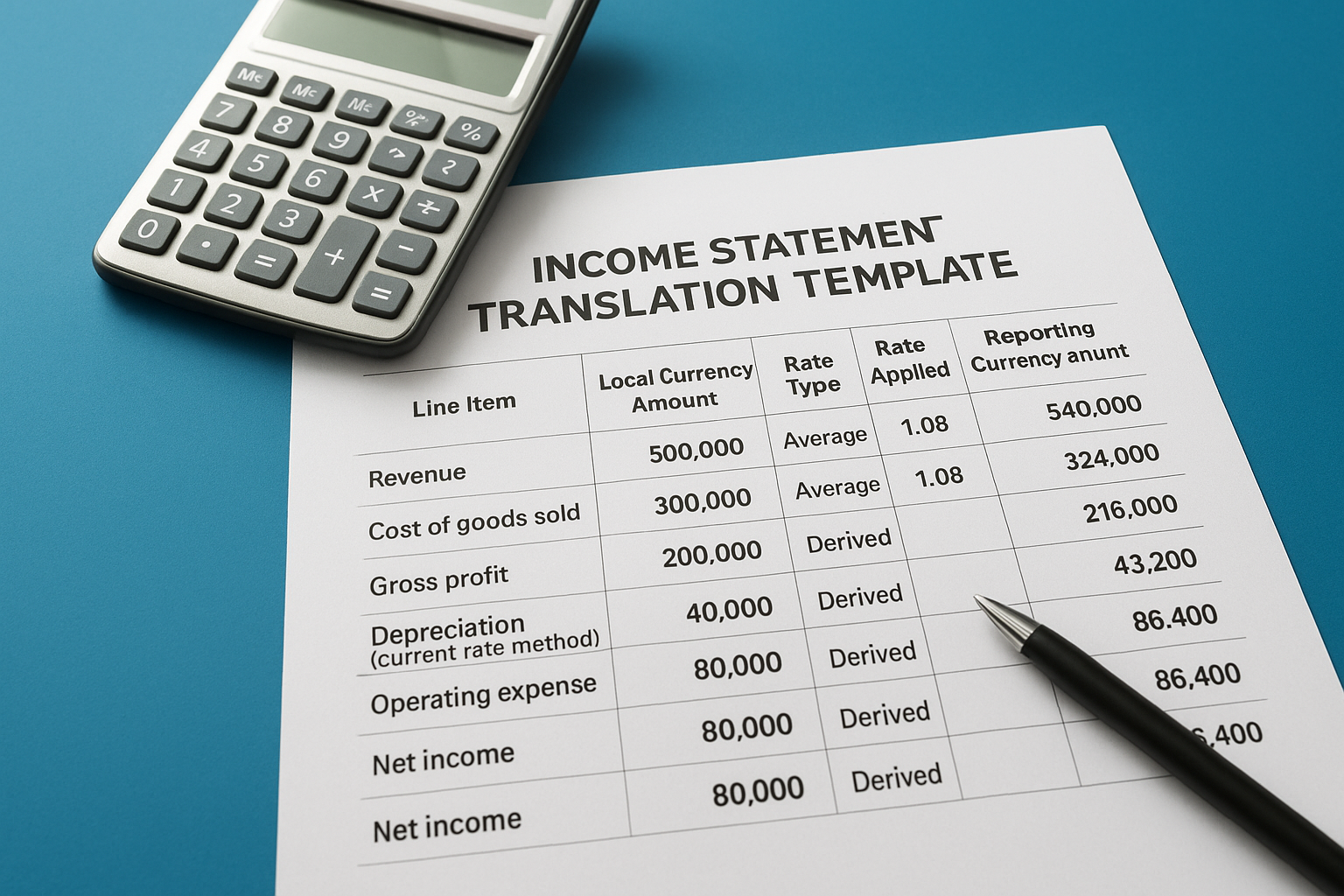
| Line Item | Local Currency Amount | Rate Type | Rate Applied | Reporting Currency Amount |
|---|---|---|---|---|
| Revenue | 500,000 EUR | Average | 1.08 | 540,000 USD |
| Cost of goods sold | 300,000 EUR | Average | 1.08 | 324,000 USD |
| Gross profit | 200,000 EUR | Derived | 216,000 USD | |
| Depreciation (current rate method) | 40,000 EUR | Average | 1.08 | 43,200 USD |
| Operating expenses | 80,000 EUR | Average | 1.08 | 86,400 USD |
| Net income | 80,000 EUR | Derived | 86,400 USD |
Your translated net income figure flows directly into the retained earnings section of the balance sheet in Step 4, so verify it before you move on.
Step 4. Translate the balance sheet and equity
The balance sheet requires more rate variation than the income statement does. Unlike revenues and expenses that all follow a single average rate, balance sheet items split across three different rate types depending on their nature. Knowing how to translate financial statements at this stage means correctly assigning each line item to the right rate before you enter a single number into your workbook.
Apply exchange rates to assets and liabilities
Under the current rate method, all assets and liabilities translate at the closing rate, which is the spot rate on the last day of your reporting period. This includes cash, receivables, inventory, fixed assets, accounts payable, and long-term debt. Under the temporal method, the rules split further: monetary assets and liabilities still use the closing rate, but non-monetary items like inventory carried at cost and property, plant, and equipment use historical rates from the original transaction dates.
If you have non-monetary assets acquired across multiple years, maintain a fixed asset schedule with each acquisition date’s historical rate to avoid having to reconstruct this data at year-end.
Use this reference table to assign rates to your balance sheet line items:
| Line Item | Current Rate Method | Temporal Method |
|---|---|---|
| Cash and cash equivalents | Closing rate | Closing rate |
| Accounts receivable | Closing rate | Closing rate |
| Inventory (carried at cost) | Closing rate | Historical rate |
| Property, plant, and equipment | Closing rate | Historical rate |
| Accounts payable | Closing rate | Closing rate |
| Long-term debt | Closing rate | Closing rate |
Translate equity at historical rates
Common stock and additional paid-in capital always translate at the historical rate in effect on the date the subsidiary originally issued those shares. Retained earnings do not get translated at a single rate; instead, you carry forward the translated balance from the prior period and add the current period’s translated net income from your income statement work in Step 3.
Your equity section translation should follow this sequence:
- Pull the prior-period translated retained earnings balance from your previous close.
- Add the translated net income figure from your completed income statement.
- Subtract any dividends declared, translated at the rate in effect on the declaration date.
- Record common stock and paid-in capital at the original historical rates.
- Leave the CTA line blank for now; you will calculate and record it in Step 5.
Once you complete this sequence, your translated equity section is ready for the final reconciliation check.
Step 5. Record CTA, check balance, and disclose
At this stage of understanding how to translate financial statements, you have a fully translated income statement and balance sheet, but the two sides of your balance sheet almost certainly do not agree. That gap is not an error; it is the cumulative translation adjustment (CTA), and it belongs in other comprehensive income (OCI) under stockholders’ equity. This step shows you how to calculate it, confirm your balance sheet ties out, and draft the disclosure your financial statements require.
Calculate the cumulative translation adjustment
The CTA absorbs the difference created when different exchange rates are applied to different parts of the financial statements. You do not need a complex formula to find it; you calculate it by working backward from your translated totals. Once you have translated all assets, liabilities, and equity items excluding the CTA, compare total translated assets to total translated liabilities plus equity. The residual figure needed to make both sides equal is your CTA for the current period.
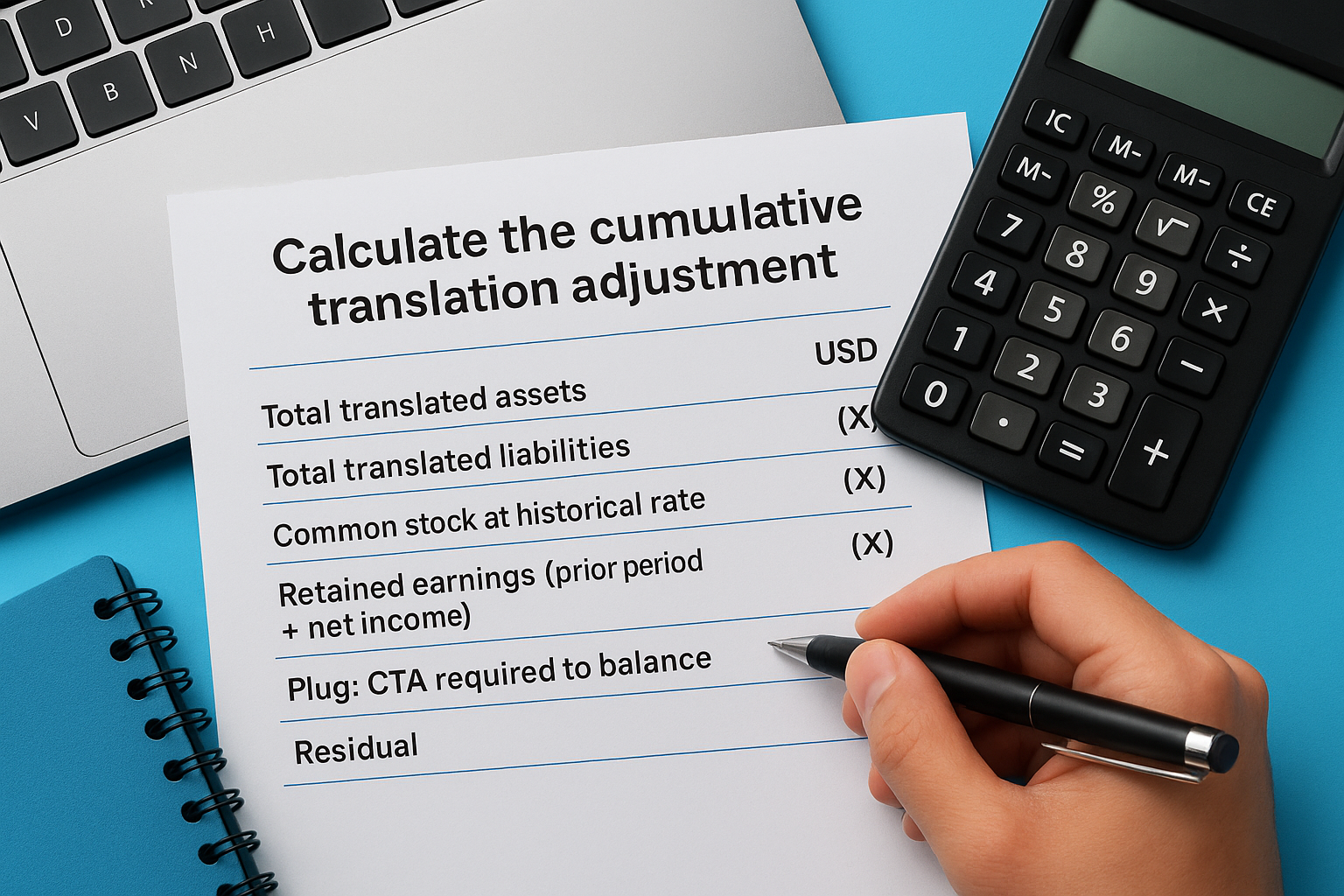
Record the CTA as a separate line item within accumulated other comprehensive income (AOCI) on the balance sheet, never net it against retained earnings.
Use this template to document your CTA calculation clearly in your workbook:
| Item | Amount (USD) |
|---|---|
| Total translated assets | X |
| Total translated liabilities | (X) |
| Common stock at historical rate | (X) |
| Retained earnings (prior period + net income) | (X) |
| Plug: CTA required to balance | = Residual |
Verify the balance sheet balances
After you record the CTA, your translated total assets must equal translated total liabilities plus total equity. Run a simple check formula in your workbook that subtracts one side from the other; the result should be exactly zero. If it is not, the problem is almost always a misclassified exchange rate on a single line item, a retained earnings carry-forward error, or a dividend translated at the wrong date rate. Trace each category systematically rather than scanning the full sheet at once.
Draft your disclosure
ASC 830 requires you to disclose the aggregate transaction gain or loss included in net income and the CTA balance in OCI. Your disclosure should state the functional currency of the subsidiary, the method used, and the exchange rates applied. Keep this language factual and specific. For example: "The Company translates the financial statements of its German subsidiary from EUR to USD using the current rate method. Assets and liabilities are translated at the closing rate of 1.08 as of December 31, and revenues and expenses are translated at the weighted average rate of 1.06 for the year ended December 31."
Final checks before you close the books
You now have a complete picture of how to translate financial statements, from functional currency determination through CTA disclosure. Before you finalize the period, run through three quick checks: confirm your balance sheet ties to zero, verify that every exchange rate traces back to a documented and auditable source, and ensure your CTA disclosure language matches the exact rates you applied to each category of line items.
Check your income statement translation separately from your balance sheet to catch any rate misclassifications before they compound into your consolidated totals. If you spot a variance, return to Step 2 and trace each rate assignment against your reference tab one line at a time rather than scanning the full workbook.
If your organization also needs the actual document text of financial statements translated into another language for regulatory submissions, audits, or legal filings, that is a separate requirement from this accounting process. Contact Languages Unlimited for certified financial document translation across 200+ languages.