



Colorado’s courts handle thousands of cases each year involving individuals with limited English proficiency, and qualified interpreters are essential to making sure everyone gets fair access to justice. The Colorado Court Interpreter Program establishes the standards, testing, and credentialing process for interpreters who want to work in the state’s courtrooms. If you’re considering this career path, understanding the specific requirements and steps involved will save you time and help you prepare effectively.
At Languages Unlimited, we’ve worked with court interpreters and legal professionals across the country since 1994, providing interpretation services for legal proceedings in 200+ languages. We know firsthand what it takes to perform at the level courts demand, and how important proper certification and training really are in this field.
This guide walks you through everything you need to know about becoming a certified court interpreter in Colorado, from eligibility requirements and orientation to the examination process and what happens after you pass. Whether you’re a bilingual professional exploring a new career or an experienced interpreter seeking Colorado-specific certification, you’ll find the details you need below.
How the Colorado court interpreter program works
The Colorado Court Interpreter Program is administered by the Colorado Judicial Branch through its Office of Language Access (OLA). The program sets the qualifications interpreters must meet before working in state courts and maintains a public roster of all approved professionals. Courts across Colorado rely on this roster when scheduling interpreters for hearings, trials, and other legal proceedings. Your placement on that roster is what gives you access to paid court assignments, so understanding how the program is structured is your first practical step.

Who oversees the program
The Office of Language Access manages testing requirements, approves training providers, updates the interpreter roster, and processes credential renewals. The program also aligns with the standards of the National Center for State Courts (NCSC), which coordinates court interpreter certification across participating U.S. states. This alignment means your Colorado credential may be recognized in other consortium states, which can expand your working opportunities over time. If you have questions during the process, the OLA is your primary point of contact, and reaching out to them early can help you avoid delays in your application.
Contacting the Office of Language Access directly before you begin ensures you have the most current requirements, since program details can change between exam cycles.
Credential levels explained
The program uses three distinct credential levels, and which one applies to you depends primarily on your target language and whether a formal certification exam exists for it.
| Credential | When it applies |
|---|---|
| Certified | For languages with an approved oral exam through the NCSC or federal consortium (e.g., Spanish) |
| Registered | For languages without an available certification exam; qualifications are assessed through an alternative review process |
| Provisionally Qualified | A temporary status for interpreters who have partially met requirements while completing remaining steps |
Spanish interpreters, for example, must pursue the certified path because a full oral exam exists. Interpreters working in languages like Somali or Tigrinya typically follow the registered pathway. Knowing your credential level upfront lets you focus your preparation on the right set of requirements rather than working through steps that may not apply to your situation.
How courts use the interpreter roster
Once you earn your credential, the OLA adds your profile to the public interpreter roster. Court administrators and judges search this roster by language and credential level when they need to schedule an interpreter. The system prioritizes certified interpreters first, followed by registered, and then provisionally qualified. This hierarchy has a direct impact on how frequently courts contact you for work. Keeping your credential active through timely renewals and completing any required continuing education hours ensures your listing stays current and visible to schedulers looking to fill assignments.
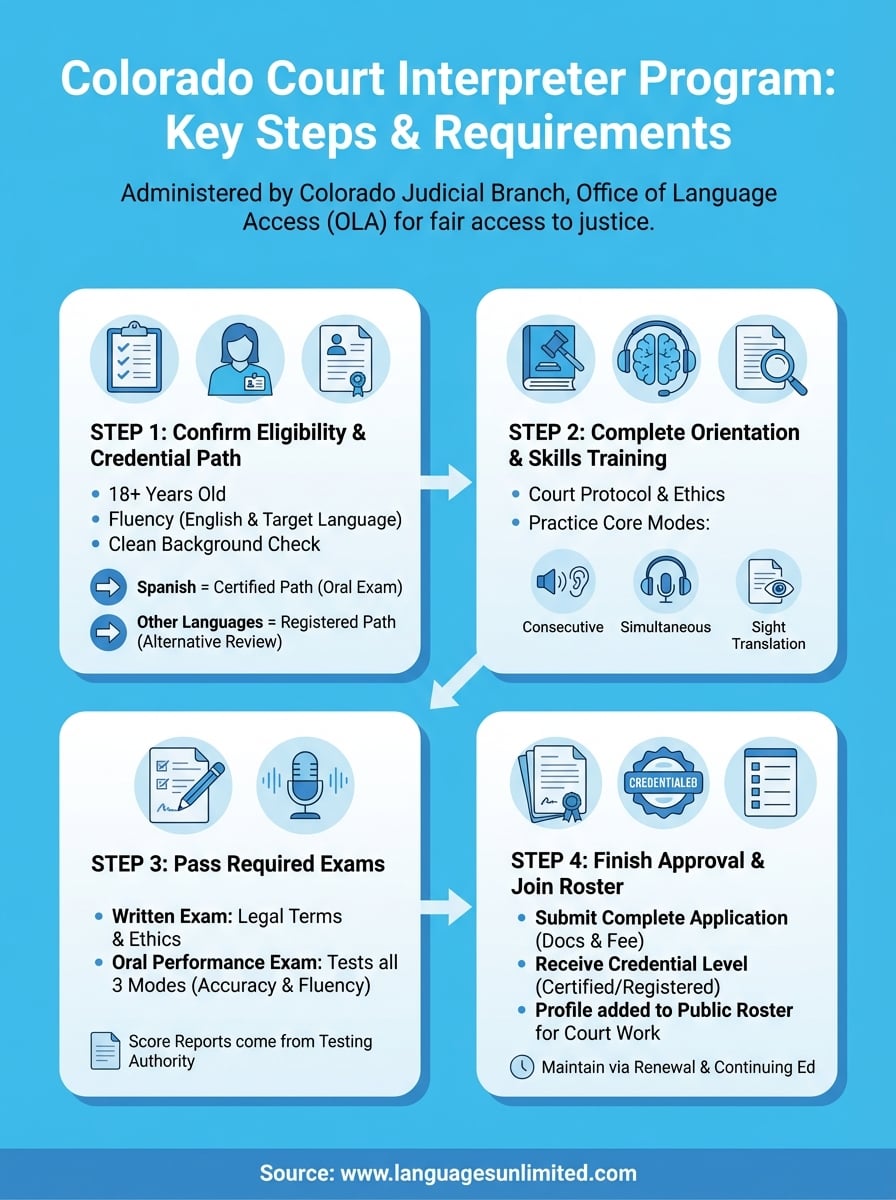
Step 1. Confirm eligibility and pick your credential path
Before you register for any exam or training, you need to confirm that you meet the basic eligibility requirements set by the Colorado Judicial Branch. Skipping this step wastes time if you have a disqualifying gap, so treat it as a genuine checkpoint rather than a formality. The colorado court interpreter program sets clear baseline criteria, and reviewing them now sets you up for a smoother application process.
Basic eligibility requirements
The Office of Language Access requires that all applicants meet a core set of conditions before moving forward. You must be 18 years of age or older and demonstrate professional-level fluency in both English and your target language. You also need a clean background check, as courts will not place individuals with certain criminal histories on the active roster.
Here is a quick checklist to verify before you proceed:
- You are at least 18 years old
- You have native or near-native fluency in English and your target language
- You can pass a criminal background check
- You have a valid government-issued ID for identity verification
- You have access to reliable transportation or remote tools to accept assignments
If you are unsure whether a prior criminal record affects your eligibility, contact the Office of Language Access directly before investing time and money in training.
Choosing your credential path
Your target language determines which credential path you follow. If you plan to interpret in Spanish, you are required to pursue the certified path and sit for the full oral exam. For languages without an available national exam, the registered pathway applies, and the OLA assesses your qualifications through an alternative review.
Look up your language on the OLA’s current language list before you commit to a preparation timeline. Confirm the path in writing with the OLA so you know exactly which exams and fees apply to your specific situation.
Step 2. Complete orientation and skills training
Once you confirm your eligibility and identify your credential path, the colorado court interpreter program requires you to complete a formal orientation and skills-based training before you sit for any exam. This step is not optional, and courts take it seriously because interpreting in a legal setting demands far more than bilingual fluency. You need to understand courtroom protocol, ethics, and professional boundaries before you ever step into a proceeding.
Complete the required orientation
The Colorado Judicial Branch requires all new court interpreter candidates to complete an approved orientation course. This course covers the code of professional responsibility, the role of an interpreter in legal settings, and the procedural norms of Colorado’s court system. You can typically complete this orientation online through the OLA-approved providers, which makes scheduling straightforward.
Here is what the orientation curriculum generally covers:
- Code of professional conduct and interpreter ethics
- Modes of interpretation: consecutive, simultaneous, and sight translation
- Courtroom roles and the boundaries interpreters must respect
- Record-keeping and professional conduct expectations
Completing orientation before attempting any skills practice gives you a framework that makes the technical training far more effective.
Build your skills through approved training
After orientation, you need to develop and sharpen your actual interpreting skills through structured practice. The OLA maintains a list of approved training providers and workshops specifically designed for aspiring court interpreters. You should focus your preparation on the three core modes: consecutive interpretation, simultaneous interpretation, and sight translation, since all three appear in real courtroom settings and in the formal exam.
Work through practice materials in both English and your target language, record yourself interpreting sample legal passages, and review your recordings for accuracy and fluency gaps. Consistent, deliberate practice over several weeks will put you in a much stronger position when you move to the exam stage.
Step 3. Pass the required exams
The exam stage is where the colorado court interpreter program formally evaluates whether your skills meet the standards courts require. Passing requires preparation across multiple components, and knowing what each test covers before you register will help you allocate your study time effectively. Both the written and oral components test different skill sets, so treat each one as a separate preparation challenge.

The written exam
The written exam tests your knowledge of legal terminology, professional ethics, and court procedure rather than your live interpreting performance. You need to demonstrate that you understand the rules that govern interpreter conduct and that you can recognize legally significant vocabulary in both English and your target language. This exam is typically administered online or at a designated testing site, and you should confirm the current format with the OLA before you schedule your seat.
Review the code of professional responsibility thoroughly before exam day, since ethics questions make up a significant portion of the test. Study legal glossaries in both languages and practice identifying terms in context rather than memorizing isolated definitions.
The oral performance exam
The oral exam is the most demanding component, and it requires you to demonstrate all three modes of interpretation under timed conditions: consecutive, simultaneous, and sight translation. Examiners score you on accuracy, fluency, register, and professional delivery, not just vocabulary recall. For Spanish, the oral exam is administered through the consortium exam coordinated by the NCSC.
Schedule your oral exam only after you have logged substantial practice hours, since attempting it before you are ready wastes your application fee and delays your roster placement.
Your score reports will come directly from the testing authority, and you need to submit passing results to the OLA as part of your credential application. Keep digital and physical copies of all your exam documentation to avoid delays in the next step.
Step 4. Finish approval steps and join the roster
Passing your exams is a major milestone, but the colorado court interpreter program requires a few more administrative steps before the OLA formally adds you to the active roster. This stage is mostly paperwork and verification, but completing it accurately and promptly is what separates candidates who wait months from those who start accepting assignments within weeks of passing.
Submit your application and documentation
You need to compile all required documents and submit them to the Office of Language Access through the official application process. Missing a single item causes delays, so gather everything before you submit rather than sending documents in separate batches.
Your complete application package should include:
- Passing score reports from both the written and oral exams
- A completed application form from the OLA
- Proof of completed orientation from an approved provider
- Government-issued photo ID
- Criminal background check results (from an OLA-approved vendor)
- Application fee payment (confirm the current amount with the OLA before submitting)
Submit your full package in one complete submission to avoid processing delays that can push your roster listing back by several weeks.
Understand roster placement and your credential status
Once the OLA reviews and approves your application, they assign your credential level (certified, registered, or provisionally qualified) and add your profile to the public interpreter roster. Courts searching for interpreters in your language will then see your listing and contact you directly for assignments.
Your credential requires renewal on a regular cycle, and the OLA will notify you of continuing education requirements before your renewal deadline. Set a calendar reminder well in advance so your listing never lapses. An inactive or expired credential removes you from active search results, which directly affects how often you receive court assignment offers.
What to do next
You now have a clear picture of what the colorado court interpreter program requires and exactly how to move through each stage. Start by confirming your eligibility and credential path with the Office of Language Access, then build your preparation timeline around the orientation, training, and exam schedule that applies to your target language. Give yourself enough lead time between each step so you’re not rushing exam registrations or document submissions at the last minute.
Your credential opens the door to consistent court assignments, but many interpreters also expand their work by partnering with professional language services firms. Languages Unlimited has connected qualified interpreters and legal clients across the country since 1994, with a network covering 200+ languages and dialects. Whether you need support finding legal interpretation assignments or want to discuss how our team works with court-qualified professionals, we’re ready to help.
Contact our team today to learn how Languages Unlimited supports interpreters and legal clients across the United States.