



Research interviews, dissertation defenses, academic lectures, focus group discussions, these recordings hold valuable data that researchers and students need in written form. Academic transcription services convert these audio and video files into accurate, searchable text that can be analyzed, cited, and archived.
Whether you’re a graduate student transcribing qualitative research interviews or a professor needing lecture notes for accessibility purposes, understanding what these services offer, and what they cost, helps you make informed decisions about your project. The right transcription partner can save you dozens of hours while maintaining the precision your academic work demands.
At Languages Unlimited, we’ve provided transcription services since 1994, supporting researchers, universities, and institutions across all 50 states. This guide breaks down what academic transcription services are, typical pricing structures, and the most common applications, so you can determine exactly what you need for your next project.
What academic transcription services include
Academic transcription services transform your audio and video files into written documents that meet specific formatting and accuracy standards. You receive more than a simple text dump; professional providers deliver structured transcripts with proper formatting, speaker identification, and time-stamping based on your research or institutional requirements.
Core deliverables
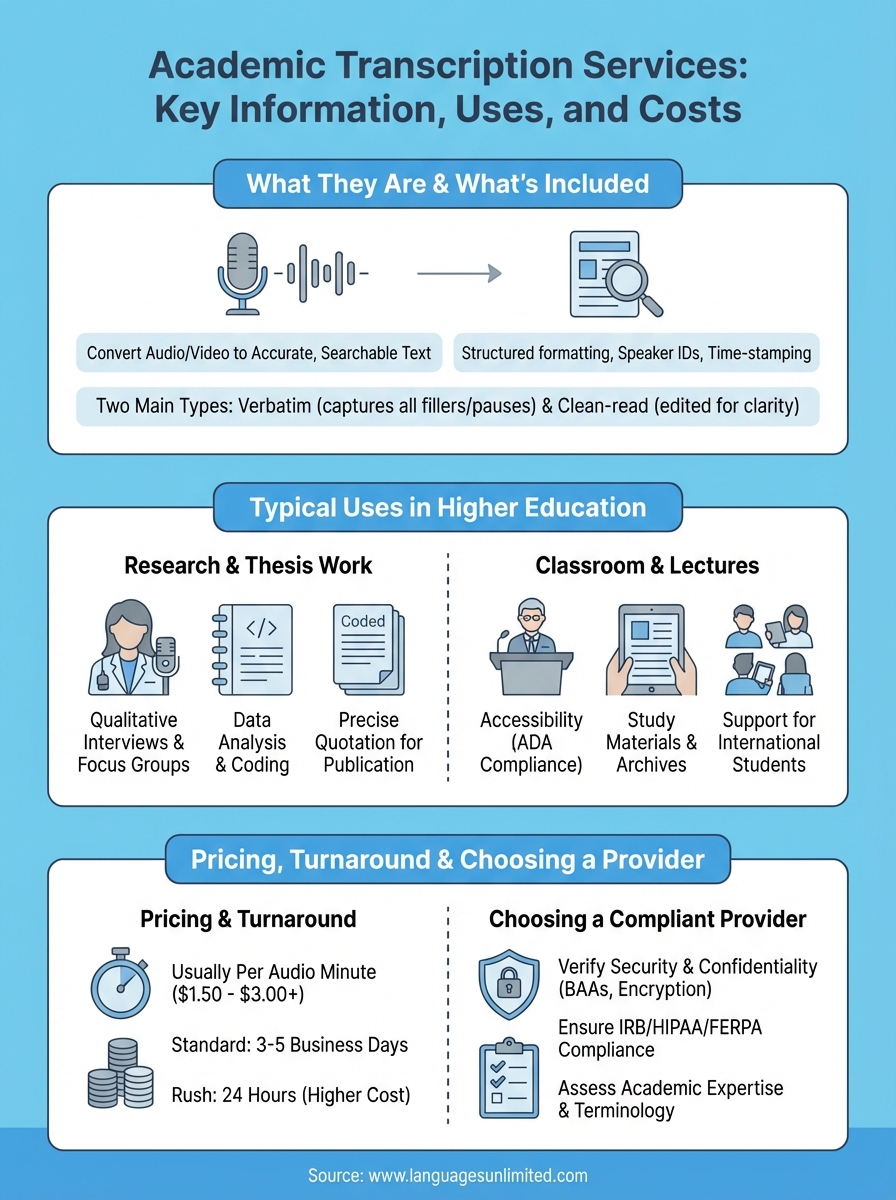
The fundamental output is a verbatim or clean-read transcript depending on your needs. Verbatim transcripts capture every word, pause, filler (um, uh), and false start, which matters when you’re analyzing speech patterns or conducting discourse analysis. Clean-read versions remove these elements while preserving the speaker’s intended meaning, making them ideal for publication, lecture notes, or general documentation. Most providers deliver files in multiple formats (Word, PDF, plain text) so you can import them directly into qualitative analysis software like NVivo or Atlas.ti.
Formatting and style options
You can specify formatting rules that align with your citation style (APA, Chicago, MLA) or university guidelines. Most academic transcription services offer:
- Speaker labels (Interviewer, Respondent 1, Dr. Smith)
- Time-stamps at regular intervals or for specific quotes
- Paragraph breaks that reflect natural speech patterns
- Phonetic spellings for technical terms or proper nouns
Professional providers also handle multilingual content, non-native speaker accents, and discipline-specific terminology from medicine to sociology.
Quality academic transcription requires both linguistic skill and subject-matter familiarity to capture technical language accurately.
Additional features for research
Beyond basic transcription, you get services that support your analytical workflow. Time-coded transcripts let you jump to specific moments in your recording when cross-referencing data. Confidentiality agreements protect sensitive research content, particularly important for IRB-approved studies or HIPAA-compliant medical research. Translation services help when your source material spans multiple languages, allowing you to conduct truly global research without language barriers limiting your sample.
Why academic transcripts matter
Written transcripts convert hours of audio into searchable, analyzable documents that you can reference instantly. You save time when you can search for specific keywords instead of scrubbing through recordings, and you preserve research integrity by creating a permanent, exact record of what was said during interviews, focus groups, or lectures.
Supporting analysis and citation
Your qualitative research depends on precise quotations that you can code, compare, and cite. Transcripts let you apply thematic analysis frameworks, identify patterns across multiple sources, and provide word-for-word evidence for your findings. When you write your dissertation or journal article, you need exact quotes with time stamps or page references that reviewers can verify. Academic transcription services ensure this documentation meets scholarly standards while giving you the flexibility to import transcripts into analysis software that speeds up your coding process.
Accurate transcripts form the foundation of credible qualitative research by providing verifiable source material.
Meeting compliance standards
Universities require accessible course materials under ADA regulations, which means recorded lectures need text versions that screen readers can process. Research involving human subjects often demands secure transcript handling that complies with IRB protocols and protects participant confidentiality. Professional transcription providers sign confidentiality agreements and follow data protection standards that your institution requires for ethical research.
Typical use cases in higher education
Academic transcription services support a wide range of university activities, from dissertation research to classroom accessibility. Understanding where these services fit helps you budget time and resources for your specific academic project.
Research and thesis work
Graduate students rely on transcription for qualitative research interviews that form the backbone of dissertations and thesis projects. You conduct interviews with research participants, record focus group sessions, or capture ethnographic observations, and transcription converts these recordings into analyzable data. Researchers in fields like sociology, education, psychology, and anthropology depend on detailed transcripts to identify themes, code responses, and support their findings with direct quotations that meet committee standards.
Classroom and lecture applications
Professors use transcription to create accessible course materials that comply with ADA requirements and support students with hearing impairments or learning differences. You record lectures, guest speaker presentations, or seminar discussions, then provide transcripts that students can review at their own pace. These documents also help international students who benefit from reading complex material in addition to hearing it, and they create searchable archives of course content that departments can reference across semesters.
Transcripts transform spoken academic content into versatile learning resources that serve multiple student populations simultaneously.
How pricing and turnaround usually work
Academic transcription services typically charge by the audio minute or audio hour, with rates varying based on audio quality, turnaround speed, and complexity. You can expect basic transcription to range from $1.50 to $3.00 per audio minute, while specialized academic work requiring technical terminology or multiple speakers costs more.
Common pricing models
Most providers structure their fees around standard turnaround times of three to five business days, with rush options available at premium rates. You pay less when you allow longer delivery windows and more when you need files within 24 or 48 hours. Audio quality directly affects pricing; clear recordings with minimal background noise cost less than files with overlapping speakers, heavy accents, or poor recording conditions. Verbatim transcription generally runs 10 to 20 percent higher than clean-read versions because it requires capturing every utterance and pause.
Professional academic transcription balances speed, accuracy, and cost based on your project’s specific requirements and timeline.
Timeline expectations
Standard delivery for academic transcription services gives you completed transcripts within three to five business days from file upload. You receive faster results when you select rush service, which delivers transcripts in 24 hours for urgent research deadlines or conference presentations. Long-form content like dissertation interviews or multi-hour focus groups may require additional time to ensure accuracy and proper formatting throughout the document.
How to choose a compliant provider
Your research data deserves protection that meets institutional standards and regulatory requirements. Academic transcription services must handle sensitive content according to IRB protocols, FERPA regulations, or HIPAA rules depending on your study type. You need a provider that understands these compliance frameworks and implements them throughout their workflow.
Verify security and confidentiality measures
Look for providers who sign Business Associate Agreements (BAAs) for HIPAA-compliant work or confidentiality agreements that protect participant identities and research data. Your transcription partner should use encrypted file transfer systems and secure storage that prevents unauthorized access to recordings or transcripts. Ask about their data retention policies and how they handle file deletion after project completion to ensure your research materials don’t persist on third-party servers longer than necessary.
Proper security measures protect both your research integrity and your participants’ privacy throughout the transcription process.
Assess academic expertise
Choose providers with demonstrated experience in academic research transcription who understand discipline-specific terminology and citation requirements. You want transcribers familiar with qualitative research methods, interview formatting conventions, and the difference between verbatim and clean-read transcripts. Check whether they can handle technical language in your field and accommodate the formatting standards your institution or journal requires for submission.
Next steps
Your academic project requires transcripts that meet research standards and institutional requirements for accuracy and formatting. Whether you’re transcribing dissertation interviews, lecture recordings, or multi-hour focus group sessions, professional academic transcription services deliver the documentation and secure handling your work demands.
Languages Unlimited has supported researchers and universities across all 50 states since 1994, providing transcription services that understand IRB compliance, maintain strict confidentiality protocols, and handle technical terminology across disciplines. We deliver verbatim or clean-read transcripts formatted to match your citation style and university guidelines, with turnaround times from standard five-day delivery to rush 24-hour service when deadlines approach.
Ready to start your project? Contact our team to discuss your specific transcription needs, upload sample audio files for quality assessment, and receive a detailed quote based on your timeline and project scope. You get experienced transcribers who protect your research data and deliver the precise documentation your academic work requires.