



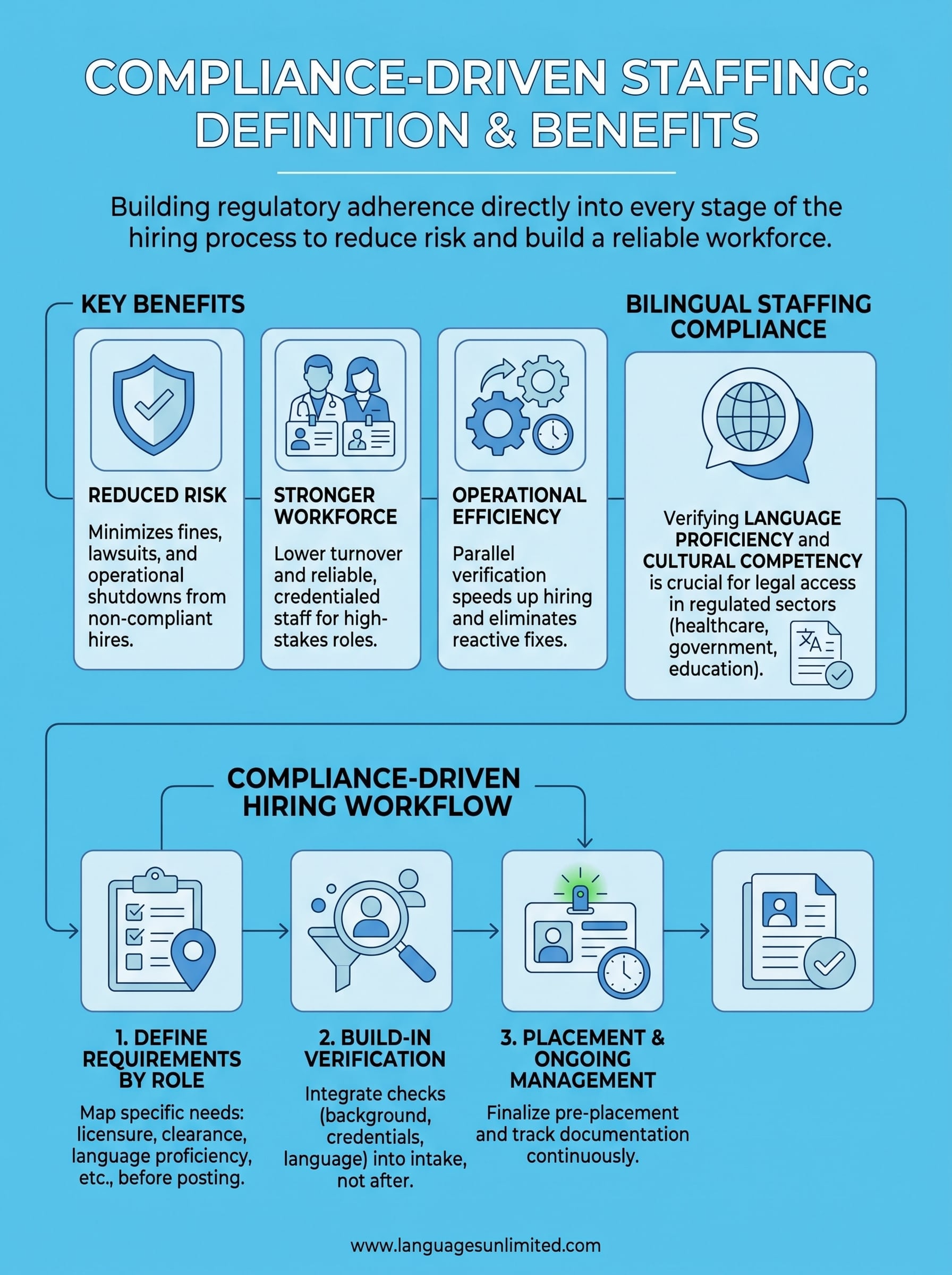
Hiring the right people is only half the equation. If those hires don’t meet federal, state, and industry-specific regulations, your organization faces fines, lawsuits, and operational shutdowns. Compliance-driven staffing is the practice of building regulatory adherence directly into every stage of the hiring process, from candidate screening to onboarding to ongoing workforce management. For industries like healthcare, government, and education, where strict credentialing and legal requirements are non-negotiable, this approach isn’t optional. It’s foundational.
At Languages Unlimited, we see the consequences of compliance gaps firsthand. Since 1994, we’ve provided bilingual and multilingual staffing solutions to hospitals, government agencies, schools, and nonprofits across all 50 states. Every placement we make, whether it’s a bilingual CNA, a cleared administrative professional, or a multilingual patient care representative, must satisfy regulatory standards specific to that role and sector. That experience has given us a sharp understanding of what compliance-focused hiring actually requires in practice.
This article breaks down what compliance-driven staffing means, why it matters, and how organizations can implement it to reduce risk while building a stronger, more reliable workforce.
Why compliance-driven staffing matters now
The regulatory environment for employers in the US has grown significantly more complex over the past decade. Federal and state labor laws, industry-specific credentialing requirements, and workforce regulations tied to government contracts have all multiplied, and enforcement has tightened along with them. If your organization operates in healthcare, government services, or education, the stakes for a non-compliant hire are high: penalties, contract losses, and reputational damage that takes years to repair.
The cost of ignoring compliance in hiring
Non-compliant hires are expensive in ways that aren’t always visible upfront. A single unvetted placement in a regulated role can trigger audits, generate fines, and expose your organization to significant liability. Placing a healthcare worker who lacks required state licensure or current background clearance, for example, violates both patient safety standards and federal employment regulations. The financial and operational fallout from that one oversight can far outweigh the cost of building a rigorous compliance-driven staffing framework from the start.
Organizations that treat compliance as a core hiring function, not an afterthought, consistently see fewer regulatory incidents and lower turnover in high-stakes roles.
Workforce complexity makes compliance harder to manage
Your workforce today is more varied than it was ten years ago. Contingent workers, part-time staff, bilingual specialists, and contractors each carry different regulatory requirements depending on their role, location, and the sector they serve. Managing documentation, credentialing, and eligibility verification across that mix requires a deliberate system, not a manual checklist.
Without one, gaps accumulate quietly until they become visible problems. State-specific licensing rules, sector mandates like those under the Joint Commission for healthcare, and federal contractor requirements under GSA schedules all demand active tracking. Reactive compliance fixes cost more, take longer, and create operational gaps your organization cannot afford.
What compliance-driven staffing means in practice
Compliance-driven staffing moves regulatory requirements out of the HR back office and into the core of your hiring workflow. Every decision, from the job description you write to the offer letter you send, reflects the specific legal and operational standards that govern your sector. It is not a separate compliance audit that happens after hiring. It is a hiring philosophy where compliance is the framework itself.
What gets verified before a placement
In practice, background checks, credential verification, and eligibility screening happen before any candidate reaches your team, not after they start. For a bilingual medical assistant, that means confirming state licensure, healthcare clearances, and language proficiency documentation as part of the intake process. For a government contractor role, it means verifying security clearance status and citizenship eligibility upfront.

Compliance-driven staffing treats every verification step as a business-critical function, not an administrative formality.
Each regulated role your organization fills carries its own checklist of mandatory documentation. When your staffing process is built around those requirements from the start, you eliminate the reactive scramble that comes from discovering compliance gaps after a placement is already active in the role.
How to build a compliance-driven staffing process
Building a compliance-driven staffing process starts with mapping the regulatory requirements specific to each role before you write a single job posting. Your organization needs a clear inventory of what each position demands, whether that’s state licensure, background clearance levels, language certifications, or federal contractor eligibility. Without that role-level documentation, your hiring team has no consistent standard to screen against.
Define your compliance requirements by role
Each role in your organization carries a distinct set of regulatory obligations that your hiring workflow must address directly. Start by categorizing positions by risk level and regulatory category: clinical versus administrative, contractor versus direct hire, public-facing versus back-office. This structure lets you build targeted screening checklists that match the actual requirements of each position.
Common compliance factors to map by role include:
- State licensure and certification requirements
- Background clearance level needed
- Language or credential documentation
- Federal contractor eligibility status
Build verification into your intake process
Your screening and verification steps should run in parallel with candidate evaluation, not after a hiring decision is made. Integrate credential checks, eligibility verification, and documentation review into your standard intake workflow so compliance gaps surface before a placement is finalized.
Catching a compliance gap before placement costs a fraction of what it costs to address one after the hire is active.
How bilingual staffing supports compliance requirements
In regulated sectors, language access is not a courtesy; it is a legal obligation. Federal law requires healthcare providers and organizations receiving federal funding to provide meaningful access to services for individuals with limited English proficiency. That means the bilingual professionals you place must meet both role-specific standards and documented language competency requirements to satisfy compliance driven staffing expectations.
Placing bilingual staff without verified language proficiency creates the same legal exposure as placing an unlicensed clinical worker.
Language qualifications belong in your screening checklist
Verifying bilingual credentials before placement is as important as verifying a medical license or background clearance. When a bilingual staff member lacks verified language proficiency, your organization carries legal exposure every time that person communicates with a patient, client, or program participant.

Your screening process should require documented language ability, not self-reported fluency, as part of the standard intake workflow alongside every other credential check. Languages Unlimited screens for both language proficiency and cultural competency before placing bilingual professionals in any regulated role.
Key language compliance factors to verify:
- Proficiency assessment results
- Experience in regulated bilingual roles
- Cultural competency screening
- Sector-specific communication standards
When to outsource compliance-driven staffing
Managing compliance driven staffing internally works well when your organization has dedicated HR staff, established verification systems, and the bandwidth to track regulatory changes across every role you hire for. When any of those conditions are missing, outsourcing to a specialized staffing partner becomes the more practical choice.
Signs your internal process is stretched
If your team is consistently catching credential gaps or documentation errors after placements are already active, your intake process needs structural support. The same applies if your organization is expanding into new states or regulated sectors where licensing rules differ from what your HR team currently manages.
A staffing partner with sector-specific compliance expertise reduces your regulatory exposure faster than rebuilding an internal process from scratch.
What a qualified staffing partner handles for you
A specialized partner manages pre-placement screening, credential verification, and ongoing documentation tracking so your internal team can focus on operations. For organizations placing bilingual or multilingual professionals in healthcare, government, or education, that partner should also verify language proficiency and cultural competency as part of the standard workflow.
Languages Unlimited handles all of this across more than 200 languages, with placements available nationwide for organizations that need qualified, compliant professionals without the administrative overhead.
Final thoughts
Compliance driven staffing is not a specialized function reserved for large organizations or heavily regulated industries. Any organization that hires workers into roles with legal, credentialing, or language access requirements needs a hiring process built around those standards from the start. Treating compliance as a separate step after hiring decisions are made creates the exact gaps that trigger audits, fines, and placement failures.
Your organization benefits most when verification, credentialing, and documentation are built into intake before a single placement is finalized. That applies whether you manage the process internally or work with a staffing partner who handles it on your behalf.
Languages Unlimited has placed qualified, compliant bilingual and multilingual professionals across healthcare, government, and education since 1994. If your organization needs staffing support that meets regulatory standards without the administrative burden, contact our team to discuss your specific requirements.