



A notarized translation is a translated document that includes a notary public’s seal and signature, verifying the identity of the person who signed the certification statement. It’s not about the notary checking the translation itself, they’re confirming that the translator or agency representative swore to the accuracy of their work under oath. This distinction trips up a lot of people, especially when they’re preparing documents for court filings, business agreements, or government submissions.
If you’ve been asked to submit a notarized translation, you probably have questions. Is it the same as a certified translation? Do you actually need one, or will certification alone satisfy the requirement? The answer depends entirely on where you’re submitting the document and what the receiving party demands.
At Languages Unlimited, we’ve handled both certified and notarized translations for legal, medical, and immigration purposes since 1994, across all 50 states and in hundreds of languages. This article breaks down exactly what a notarized translation involves, walks through the process step by step, and clarifies how it compares to a certified translation so you can determine which one you actually need.
What a notarized translation is in the US
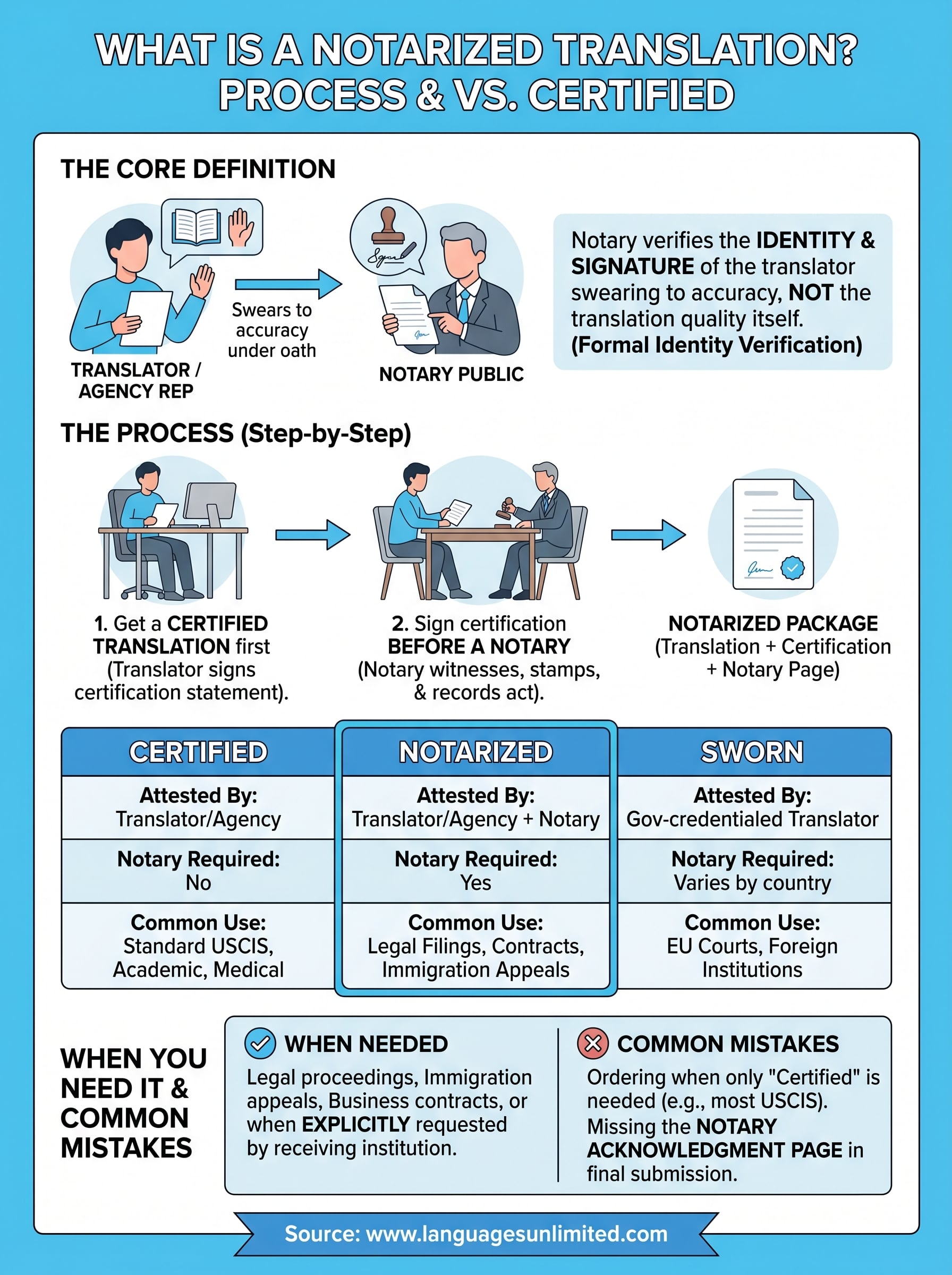
In the United States, a notarized translation is a translated document accompanied by a notarial acknowledgment, which includes the notary’s seal, signature, and commission expiration date. The notary public does not evaluate the translation’s accuracy or need to know the target language. Their role is strictly procedural: they verify the identity of the signer, usually the translator or an agency representative, and confirm that the person signed a sworn statement declaring the translation complete and accurate.
A notary public in the US cannot certify the quality of a translation. Their seal only confirms the identity and oath of the person attesting to its accuracy.
What the notary actually verifies
The translator or agency representative appears before a notary public and signs a certification statement declaring that the translation is accurate and complete to the best of their knowledge. The notary then witnesses that signature, stamps the document, and records the act in their notarial log. That is the full scope of notarial involvement in a translation. They do not compare the original document to the translated version, and they have no obligation to do so.

This distinction matters when you are deciding what type of document authentication you need. Many clients assume the notary seal signals some form of linguistic quality review. It does not. The accuracy of the translation still rests entirely with the translator or the language service provider you hire. The notary simply adds a formal layer of identity verification.
How this fits into the US legal framework
Unlike some countries that rely on court-certified sworn translators who hold government-approved credentials to produce legally binding translations, the United States has no federally recognized system of sworn translators. Instead, US institutions rely on certified translations paired with notarization when a higher level of formality is required. Different states may have slightly varying notarial requirements, and certain federal agencies or courts may specify exactly what format they expect from a submitted translation.
Knowing what is a notarized translation within the US legal system means recognizing it as a procedural formality built around the notary public system, not a separate translation credential. The notary seal adds documented accountability to the process, making it harder to dispute who attested to the document’s accuracy, which is exactly why certain institutions specifically request it.
When you need a notarized translation
Not every translation project requires notarization, and requesting it unnecessarily adds cost and processing time to your submission. The clearest signal that you need a notarized translation is when the receiving institution explicitly states it in their documentation requirements. Always check the specific submission guidelines before ordering, because assuming you need notarization can be just as problematic as missing it entirely.
If an institution asks for a "notarized translation," confirm in writing that their requirement is for notarization specifically and not just certification, since the two terms get used interchangeably by mistake more often than you’d expect.
Common situations that require notarization
Several document types and submission contexts consistently require notarized translations in the United States. Legal proceedings, including certain court filings and depositions, frequently require this level of authentication to establish a documented chain of accountability for the translated content.
Other common situations include:
- Immigration appeals or consular processing beyond standard USCIS submissions
- Business contracts submitted to foreign entities or international arbitration bodies
- Real estate transactions involving parties who signed documents in a foreign language
- Licensing board submissions for regulated professions that require foreign academic credentials
When notarization is not required
Understanding what is a notarized translation also means knowing when you can skip it. Standard USCIS document submissions, such as birth certificates and marriage licenses for green card applications, typically require only a certified translation, not a notarized one. Many corporate and educational institutions accept certified translations without notarization unless their internal policies explicitly state otherwise. When in doubt, ask the requesting party directly before placing your order.
How the notarized translation process works
Understanding what is a notarized translation becomes much clearer once you see the steps in order. The process follows a straightforward sequence that combines professional translation work with a formal notarial act. You don’t need to manage each step on your own, but knowing the order helps you avoid delays and submit the right documents the first time.

Step 1: Get a certified translation completed first
The notarization process starts with a qualified translator or language service provider producing a complete, accurate translation of your source document. Once the translation is finished, the translator or an authorized agency representative prepares a written certification statement declaring the translation is accurate and complete to the best of their knowledge. This statement is the document the notary will later witness being signed, so it must be present before you schedule the notarial appointment.
Step 2: Sign the certification before a notary public
The translator or agency representative must appear in person before a commissioned notary public to sign the certification statement. The notary verifies the signer’s government-issued identification, witnesses the signature, applies their official seal, and records the act in their notarial log.
The notary’s seal does not validate the translation quality. It only confirms that a specific person signed a sworn statement about that translation on a specific date.
Your completed notarized package typically includes the original certified translation, the signed certification statement, and the notary’s acknowledgment page. Some institutions also require the original source document attached. Always confirm the exact submission format with the receiving party before placing your order.
Notarized vs certified vs sworn translations
Three terms get used interchangeably in translation requests, but they mean different things and carry different legal weight depending on the institution or country involved. If you’re trying to determine what is a notarized translation versus the other two options, the key difference comes down to who is accountable and what formal steps are attached to that accountability.
| Type | Who attests | Notary required | Common use |
|---|---|---|---|
| Certified | Translator or agency | No | USCIS, academic, medical |
| Notarized | Translator or agency + notary | Yes | Legal filings, contracts |
| Sworn | Government-credentialed translator | Varies by country | EU courts, foreign institutions |
Certified translation
A certified translation includes a signed statement from the translator or agency declaring the translation accurate and complete. No notary is required, and this format meets the standard for most USCIS submissions, academic transcripts, and medical records in the United States. It is the baseline level of formal authentication for translated documents in the US.
Sworn translation
A sworn translation is a concept tied to countries that maintain a registry of court-authorized translators, common across much of Europe and Latin America. These translators hold government-issued credentials that make their translations legally binding without any additional notarization step. The credential itself carries the legal authority.
If a foreign institution asks for a sworn translation, do not substitute a notarized translation without confirming they are equivalent in that jurisdiction, because they often are not.
The United States has no equivalent sworn translator system, so US institutions rely on certified or notarized translations instead. Knowing which format applies to your specific submission saves you time and prevents a costly rejection.
Common mistakes and quick FAQs
Even after understanding what is a notarized translation, people still make avoidable errors when ordering or submitting them. The most expensive mistakes happen before the translation is ordered, usually because someone assumed their institution’s requirements without confirming them directly.
Always verify the exact format your institution requires before placing a translation order, because a rejection means starting the process over from scratch.
Mistakes that cause rejections
The two most common errors are ordering notarization when certification is sufficient and submitting the translated document without the notary acknowledgment page attached. Both delay your application and cost you extra money to fix. A third frequent problem is ordering from a translator who signs a certification statement but is not authorized to appear as an agency representative before a notary.
- Skipping verification: Assuming a certified translation satisfies a specific request for notarization
- Missing pages: Submitting the translated text without the notary’s acknowledgment attached as part of the package
- Unauthorized signers: Using a translator who cannot legally represent the agency before a commissioned notary
Quick FAQs
Here are the questions clients ask most often before placing a translation order. Getting clear answers to these saves you time and prevents unnecessary rejections.
Can a notary translate the document for you? No. A notary public plays no role in producing or reviewing the translation. Their involvement is limited to witnessing the signature on the certification statement.
Does USCIS require notarization? Generally, no. Standard USCIS submissions accept certified translations without a notary seal. Check USCIS.gov for current requirements before you order.
Final takeaways
Knowing what is a notarized translation comes down to one core point: the notary confirms the identity of the person who swore to the translation’s accuracy, not the accuracy itself. The translator or language service provider still carries full responsibility for producing a correct, complete document. Notarization adds a formal layer of accountability that certain institutions require, but it does not replace quality translation work.
Before you order, confirm the exact format your institution requires in writing. Ordering the wrong type of authentication delays your submission and costs you extra to correct. If your institution asks for notarization, make sure your provider delivers the full package: the translated document, the signed certification statement, and the notary acknowledgment page together.
Languages Unlimited has handled certified and notarized translations across hundreds of languages since 1994. If you’re ready to move forward or still have questions, reach out to our team and we’ll confirm exactly what your submission requires.