



A single mistranslated clause in a contract can void an agreement, delay an immigration case, or expose a company to liability. That’s the reality of legal translation, a discipline where precision isn’t optional, it’s everything. Unlike translating a blog post or a marketing brochure, legal documents carry binding legal weight, and the translator must understand both the language and the legal system behind it.
So what exactly does legal translation involve, who needs it, and what does it cost? Whether you’re a law firm preparing documents for international litigation, a healthcare organization navigating compliance across languages, or an individual submitting paperwork to USCIS, the answers matter more than you might expect. Getting it wrong has consequences that go well beyond a typo, we’re talking rejected filings, courtroom disputes, and financial penalties.
At Languages Unlimited, we’ve provided certified legal translation services since 1994, working with law firms, government agencies, corporations, and individuals across all 50 states. With over ten thousand language professionals, ATA membership, USCIS approval, and a GSA contract, we handle legal documents daily, from immigration petitions to multinational contracts. This article breaks down what legal translation actually means, walks through common document types and examples, and gives you a realistic picture of what it costs and why.
Why legal translation matters
To understand why legal translation carries so much weight, you need to recognize how different legal language is from everyday language. Legal texts are drafted with precision, where every word choice has intentional meaning that courts, agencies, and parties rely on. When you translate that content into another language, you’re not just converting words, you’re transferring legal obligations, rights, and limitations across linguistic and jurisdictional lines. A mistake at any point in that process can compromise the entire document.
Legal language leaves no room for approximation
Legal documents are full of terms with no direct equivalent in another language. A contract written in English may reference concepts like "indemnification," "estoppel," or "liquidated damages" that don’t map neatly onto equivalent terms in Spanish, Arabic, or Mandarin. A translator who isn’t fluent in both the source and target legal systems will substitute the closest-sounding word, which can change the meaning of a clause entirely. This is exactly why understanding what is legal translation really means recognizing it as a legal and linguistic task at the same time.
If your translator understands Spanish but not contract law, you still have a problem.
Legal systems also vary significantly by country. The U.S. operates under common law, while many European and Latin American countries follow civil law traditions. Those structural differences affect how legal concepts are interpreted, so a translator needs to understand not just vocabulary but the legal framework the document operates within.
Errors produce real consequences
When a legal translation contains an error, the fallout isn’t limited to an awkward sentence. Rejected immigration applications are one of the most common outcomes when personal documents like birth certificates or marriage licenses are translated inaccurately or without proper certification. Courts can refuse to accept exhibits or evidence that arrive with deficient translations, forcing costly delays and re-filings.
In commercial settings, a mistranslated clause in an international contract has triggered arbitration disputes, voided agreements, and created significant financial liability for businesses that assumed their translated documents were accurate. Healthcare organizations working with non-English-speaking patients face a different but equally serious risk: patient intake forms, consent documents, and insurance filings that carry errors can expose providers to compliance violations and malpractice risk.
The stakes rise in regulated industries
If you work in healthcare, law, government, or immigration, the accuracy bar for any document you submit is high, and that bar doesn’t lower because the document has been translated. Regulatory agencies, courts, and USCIS all require that translated documents faithfully represent the original, and they expect certified translators who can stand behind their work with a signed attestation.
Government agencies in particular operate under strict standards. The U.S. Citizenship and Immigration Services requires that all foreign-language documents submitted with applications include a full English translation accompanied by a certification from the translator confirming accuracy and competence. A translation that skips this step, or that includes errors, results in a request for evidence or an outright rejection.
Federal contractors and agencies subject to accessibility regulations face additional layers of compliance. Section 508 of the Rehabilitation Act mandates accessible communication standards, and multilingual content must meet those same requirements. When legal documents cross both language and compliance boundaries, the need for experienced, qualified translators becomes even more critical, not less.
How legal translation works step by step
Understanding what is legal translation means understanding the process behind it, not just the definition. When you submit a legal document for translation, the work that follows is more structured than most people expect. Each stage serves a specific purpose, and skipping any one of them is where accuracy problems tend to appear.
From document review to translator assignment
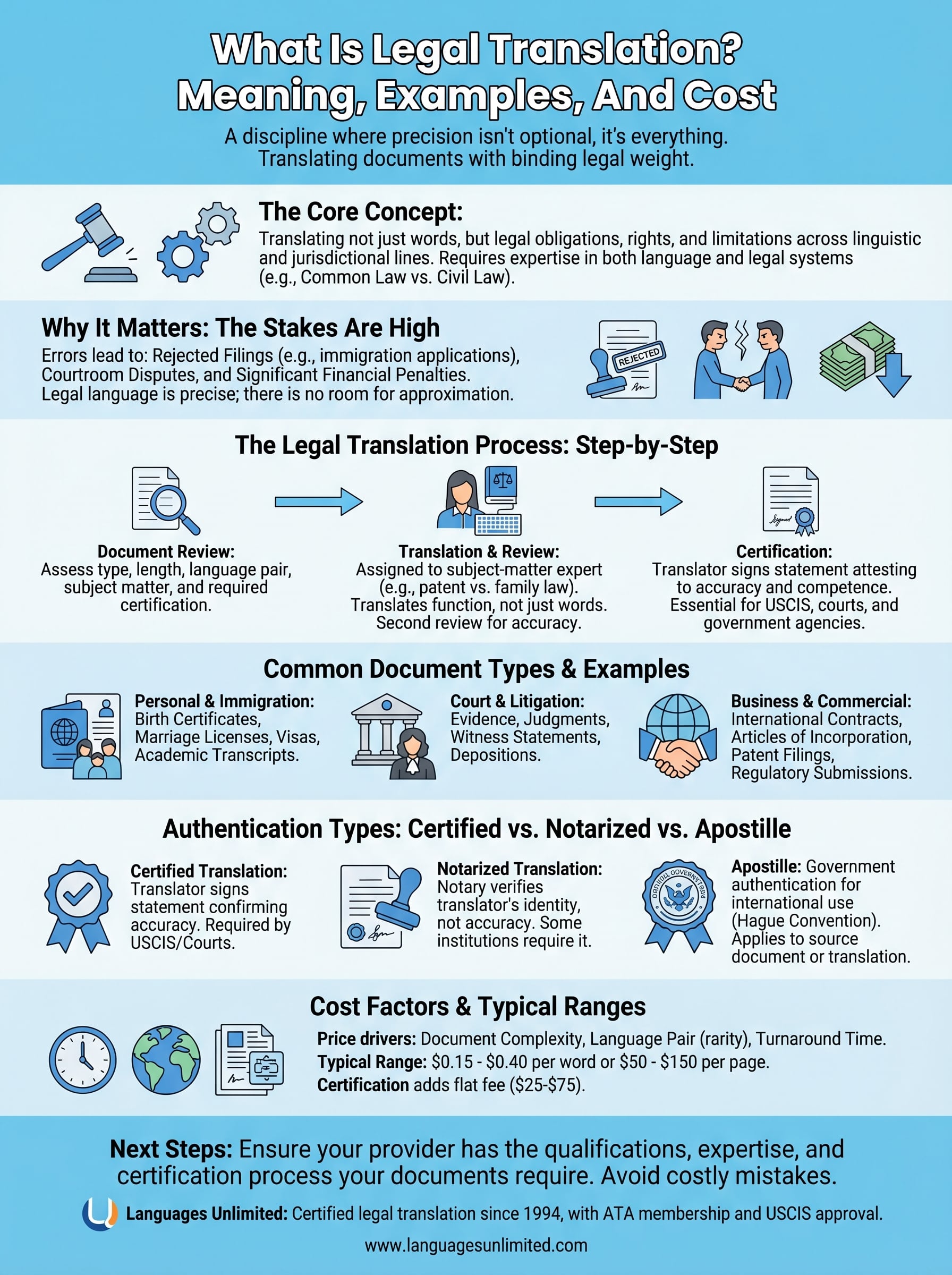
Before any translation begins, your provider reviews the document to understand its type, length, language pair, and subject matter. A corporate contract involves different terminology than an immigration affidavit or a court judgment, and that distinction determines which translator handles your work. This initial review also establishes what certification or additional authentication the final document requires, so there are no surprises at the submission stage.
Once the scope is clear, the document goes to a translator with subject-matter expertise in the relevant legal area. A translator working on a patent filing needs a different background than one handling a custody order or a real estate deed. Reputable providers maintain networks organized by specialty, which means your immigration documents don’t get assigned to the same translator who works on multinational contracts. Matching the translator to the document type is one of the most critical quality controls in the entire process.
Translation, review, and certification
The translator works through the document systematically, preserving not just the meaning but the legal function of each clause, term, and provision. Legal texts often contain terminology with no direct equivalent in the target language, and a qualified translator resolves those gaps using knowledge of both legal systems, not by substituting the closest-sounding word. This combination of linguistic and legal knowledge is what separates professional legal translation from a general translation tool.
Accuracy in legal translation isn’t just about words. It’s about whether the translated document carries the same legal weight as the original.
After the initial translation is complete, a second reviewer checks the work against the source document for accuracy, formatting, and completeness. Once the review passes, the translator signs a certification statement confirming competence in both languages and attesting that the translation is accurate and complete. For court filings, USCIS submissions, and government documents, this certified output is the specific deliverable those agencies require before they will accept your paperwork.
What documents usually need legal translation
Many people assume legal translation applies only to courtroom materials, but the reality is much broader. If you’re dealing with any document that carries legal weight, or that a government agency, court, or institution will act upon, it likely needs professional legal translation. Knowing which document types fall into this category helps you avoid submitting incomplete or improperly translated paperwork.
Personal and immigration documents
The most common category involves personal documents submitted to immigration authorities or foreign governments. If you apply for a visa, green card, or citizenship, USCIS requires certified translations of documents such as birth certificates, marriage licenses, divorce decrees, and adoption records. Any foreign-language document attached to your application must come with a full English translation and a signed certification from a qualified translator.
If a single personal document in your application arrives without proper certification, USCIS can issue a Request for Evidence, which delays your case by weeks or months.
Academic transcripts and diplomas also fall into this category. If you’re applying to a U.S. university or professional licensing board and your credentials come from a foreign institution, those records need accurate, certified translation before the evaluating body will review them.
Court and litigation documents
Legal proceedings frequently require translated materials, especially in cases involving international parties, foreign evidence, or cross-border disputes. Courts expect translated versions of contracts, witness statements, police reports, and judgments that originate in another language. These translations need to preserve not just the words but the legal function of the original, so a qualified translator with litigation experience handles this work differently than one focused on personal documents.
Depositions, subpoenas, and criminal records also appear regularly in this category. If you’re a law firm handling a case with foreign-language exhibits, those materials need certified translation before the court will admit them as evidence.
Business and commercial documents
Companies operating across borders routinely submit documents for translation that carry direct financial and legal consequences. Understanding what is legal translation in a commercial context means recognizing that a poorly translated contract clause doesn’t just create confusion, it creates contractual exposure your business may not catch until a dispute surfaces.
Common business documents that require legal translation include:
- International contracts and service agreements
- Articles of incorporation and company bylaws
- Patent applications and intellectual property filings
- Regulatory submissions and compliance documents
- Financial statements for cross-border transactions
Certified vs notarized vs apostille translations
When you submit translated documents to a government agency, court, or institution, they don’t just ask for "a translation." They specify what type of authentication that translation requires, and those requirements differ depending on the agency, the country, and the purpose of the document. Confusing certified, notarized, and apostille translations is one of the most common reasons submissions get rejected. Understanding each category clearly before you submit saves you time, money, and the frustration of starting over.
What a certified translation is
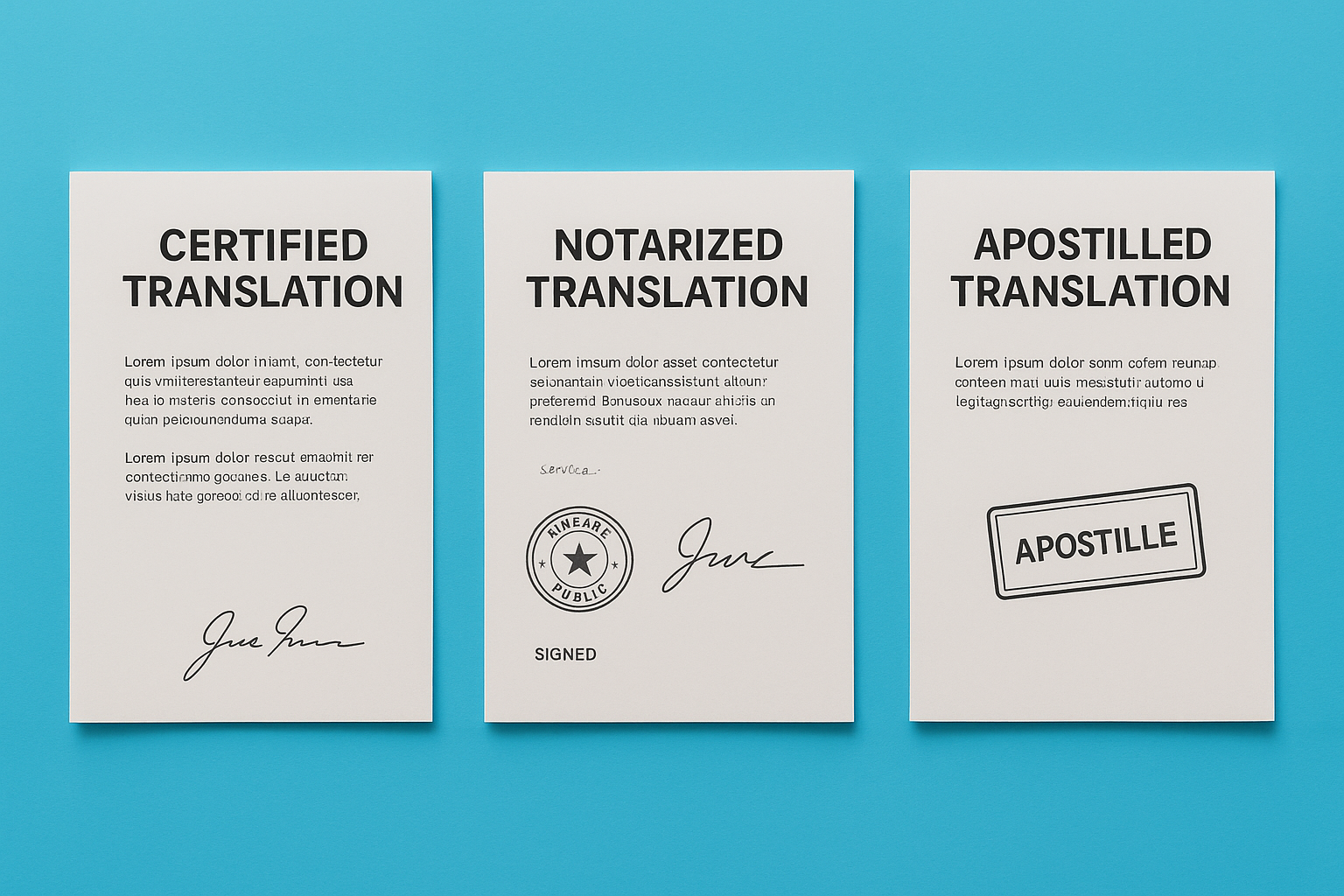
A certified translation is a document translated by a qualified professional who signs a statement confirming that the translation is accurate and complete to the best of their knowledge and competence. The translator, not a government body, provides this attestation. USCIS and most U.S. courts require certified translations for any foreign-language documents included in filings or applications. The signed certification is what makes the document acceptable, not a government seal or external approval. If someone provides you with a translation that lacks this signed statement, it does not meet the standard those agencies require.
A certified translation is not the same as a translation done by a certified translator. The certification comes from the attestation statement, not from any credential the translator holds.
What a notarized translation is
A notarized translation takes the certified translation one step further. After the translator completes and certifies the work, a licensed notary public verifies the identity of the translator and witnesses their signature on the certification statement. The notary does not verify the accuracy of the translation itself, only that the person signing is who they say they are. Some institutions, foreign embassies, and private organizations require notarization in addition to certification, so you should confirm what the receiving party specifically requests before you submit.
What an apostille is and when you need one
An apostille is an official authentication certificate issued by a government authority that verifies the legitimacy of a document for use in another country that participates in the Hague Convention. When you need a translated document recognized internationally, the apostille process typically applies to the underlying source document, though some situations require both the original document and its translation to carry apostille authentication. The U.S. Department of State and individual state authorities issue apostilles for documents intended for use abroad, and what is legal translation in an international context often involves navigating this multi-step authentication process alongside the translation itself.
Why legal translation is hard and error-prone
Part of understanding what is legal translation means recognizing why it fails so often even when the translator is fluent in both languages. Legal documents are not just complex text, they are systems of interdependent clauses, references, and obligations where a single error in one place can distort the meaning of everything that follows. Fluency in two languages gives a translator the tools to work, but it does not automatically give them the legal knowledge to use those tools correctly.
Legal systems don’t map onto each other
Every country structures its legal system differently, and those structural differences create problems that have no clean solution in translation. Common law systems like the one used in the United States rely on judicial precedent, while many other countries operate under civil law traditions that are codified into statutes. A term that carries a precise meaning in a U.S. court may not have a functional equivalent in a civil law jurisdiction, and forcing a translation without acknowledging that gap produces a document that looks complete but carries a different legal meaning than the original.
Translating a legal document without understanding the target legal system is like converting a recipe using ingredients that don’t exist in the destination country.
This problem compounds when you factor in regional legal variations within a single language. Spanish spoken in Mexico operates within a different legal framework than Spanish spoken in Spain or Colombia. A translator who chooses terminology based on one country’s legal system may produce a document that is technically readable but legally incorrect in the jurisdiction where it will actually be used.
Terminology gaps produce errors that are hard to catch
Legal jargon is dense, and many terms have no direct equivalent across languages. When a translator lacks the background to navigate these gaps, they often substitute familiar words that carry a different legal weight in the target language. These substitutions are particularly dangerous because they don’t always look like errors on first read. A document with subtle terminology errors can pass an initial review, clear an internal check, and reach a government agency or a court before anyone identifies the problem.
Formatting and structure introduce additional risk. Legal documents follow strict conventions around numbering, cross-references, and clause hierarchy that must carry over into the translation intact. When those structural elements shift during translation, the document becomes internally inconsistent, and those inconsistencies tend to surface only during enforcement or dispute, exactly when you can least afford them.
Legal translation vs legal interpretation
People use "translation" and "interpretation" interchangeably, but they describe two distinct services that operate in completely different settings. Knowing which one you actually need before you contact a provider saves you time and ensures the right professional handles your situation. Understanding what is legal translation also means understanding what it is not, and legal interpretation is one of the most common points of confusion.
How each service works
Translation deals with written documents. A legal translator receives a source document, works through it carefully, and produces a written version in the target language. The work is asynchronous, meaning the translator has time to research terminology, consult references, and apply multiple review passes before delivering a final product. That structured process is part of why certified legal translation carries such precision.
Interpretation, by contrast, deals with spoken language in real time. A legal interpreter works during live events, such as court hearings, depositions, client meetings, and immigration interviews, converting spoken words from one language to another on the spot. Interpreters work either consecutively (waiting for the speaker to pause before rendering the statement in the target language) or simultaneously (speaking in real time as the original statement is delivered). Both modes require a different skill set than translation, and legal interpreters must apply that skill under immediate time pressure with no opportunity to revise.
The difference matters practically: if you need a translated contract for a court filing, you need a translator; if you need someone present during a deposition, you need an interpreter.
When you need one versus the other
Your choice depends entirely on the nature of the task. If you are submitting documents to USCIS, filing exhibits in court, registering a contract in a foreign jurisdiction, or providing a certified copy of personal records, you need a legal translator. The output is a written document that carries a certification statement and meets agency requirements.
If you are attending a hearing, conducting a cross-border negotiation, handling a patient consultation, or running a multi-party mediation session involving participants who speak different languages, you need a qualified legal interpreter. Some situations require both services, for example, a court case where you submit translated evidence and also bring an interpreter for the live proceedings. Identifying which service applies to each component of your situation keeps the process moving without gaps.
How much legal translation costs
Legal translation pricing varies considerably depending on the document, the language pair, and the level of authentication required. Most providers charge by the word or by the page, and the rates for legal work run higher than general translation because the qualifications and review process required are more demanding. Understanding the cost structure upfront helps you budget accurately and avoid surprises when you receive a quote.
What drives the price up or down
Several factors directly affect what you pay for legal translation. Document complexity is the biggest variable. A standard birth certificate involves straightforward text and a predictable format, while a multinational arbitration agreement contains dense, interdependent clauses that require significantly more time and legal knowledge to translate accurately. That difference shows up in the final price.
Language pair also plays a major role. Translating between English and Spanish or French costs less than translating between English and less common languages like Tigrinya or Haitian Creole, simply because fewer qualified translators work in those combinations. If your document requires a rare language or regional dialect, expect to pay more, and expect the pool of available translators to be smaller. Turnaround time adds another layer: standard timelines are cheaper than rush jobs, and large volumes delivered quickly carry a premium.
When what is legal translation comes into play, the cost also reflects the legal expertise involved, not just the word count.
Typical price ranges to expect
Most legal translation services in the United States charge between $0.15 and $0.40 per word for standard language pairs, with the lower end applying to common languages and straightforward documents, and the upper end reflecting complex legal content or less common languages. Page-based pricing typically falls in the $50 to $150 per page range, depending on the same factors.
Certification adds a flat fee on top of the base translation cost, usually $25 to $75 per document, and notarization adds another layer if your receiving agency requires it. If you need an apostille, that involves a separate government process with its own fees, which vary by state. For most personal immigration documents, you should budget at least $100 to $200 per document once translation and certification are combined. For business contracts or court filings, total costs scale with volume and complexity, so requesting an itemized quote before the work begins gives you the clearest picture of what to expect.
Next steps for your legal documents
Now that you understand what is legal translation and what separates it from general translation work, the next step is straightforward: make sure the provider you choose has the qualifications, subject-matter expertise, and certification process your documents actually require. Not every translation service handles legal work with the rigor that courts, USCIS, and government agencies demand. Choosing the wrong provider often means starting the entire process over.
At Languages Unlimited, we’ve handled legal document translation for law firms, government agencies, healthcare organizations, and individuals across all 50 states since 1994. Our network includes over ten thousand language professionals, and our services carry ATA membership, USCIS approval, and a GSA contract. Whether you need a single certified birth certificate or a large-scale multilingual contract, we match your documents to translators with the right legal background. Contact our team today to get a quote and move your project forward.