



Hiring a conference interpreter is one of those expenses that can catch event planners off guard. Conference interpreter rates vary widely depending on language pair, event format, location, and the interpreter’s credentials, and without a clear benchmark, it’s easy to either overpay or underbudget. Whether you’re organizing a multilateral summit, a medical symposium, or a corporate shareholder meeting, knowing what to expect in 2026 helps you plan with confidence.
At Languages Unlimited, we’ve been providing professional interpretation services since 1994, including simultaneous and consecutive conference interpretation across all 50 states. With a network of over ten thousand interpreters covering hundreds of languages, we work with government agencies, healthcare systems, legal firms, and corporations that need reliable language support at scale. That experience gives us a grounded perspective on what conference interpretation actually costs, and why.
This article breaks down current hourly and daily rates for conference interpreters, explains the factors that drive pricing up or down, and offers practical budgeting guidance. By the end, you’ll have the numbers and context you need to allocate your interpretation budget accurately and hire the right professionals for your next event.
Why conference interpreter rates vary
Conference interpreter rates don’t follow a single price list. Multiple variables interact to set the final number, and understanding each one helps you anticipate costs before you request a quote. The range can run from a few hundred dollars per day for a short consecutive session to several thousand dollars for a full simultaneous interpretation setup with specialized technical equipment.
Language pair and subject matter
Language pair is one of the most direct cost drivers. Common language combinations, such as English-Spanish, draw from a larger pool of qualified interpreters, which keeps prices competitive. Rare language pairs, like English-Mongolian or English-Tigrinya, require sourcing from a much smaller talent pool, and that scarcity pushes rates higher. Subject matter adds another layer: an interpreter covering a medical symposium or a legal arbitration needs domain-specific knowledge that commands a premium over a general business session.
The more specialized the language pair and subject matter, the fewer qualified interpreters are available, and that limited supply directly raises the rate.
Interpretation mode and event format
Simultaneous interpretation requires the interpreter to render speech in real time while the speaker continues talking, which is cognitively demanding and typically requires working in two-person teams. It also demands sound booths, headsets, and audio distribution equipment, all of which add to your total cost. Consecutive interpretation, where the interpreter waits for the speaker to pause before translating, is less equipment-intensive but extends the overall length of your event. Remote formats can reduce travel and equipment costs but carry their own technical requirements.
Interpreter credentials and experience
Certified interpreters with credentials from recognized professional bodies typically charge more than uncertified professionals. Their rates reflect documented training, professional accountability, and a verified track record in high-stakes settings. Years of field experience also factor into pricing: an interpreter who regularly handles federal government hearings or international summits will price their services to match, and for critical events, that experience reduces risk and justifies the higher rate.
Typical conference interpreter rates in 2026
Conference interpreter rates in 2026 generally fall within predictable ranges, even though individual quotes will shift based on the factors covered above. Having baseline numbers in mind before you contact a provider puts you in a stronger position to evaluate proposals and spot outliers.

Hourly rates
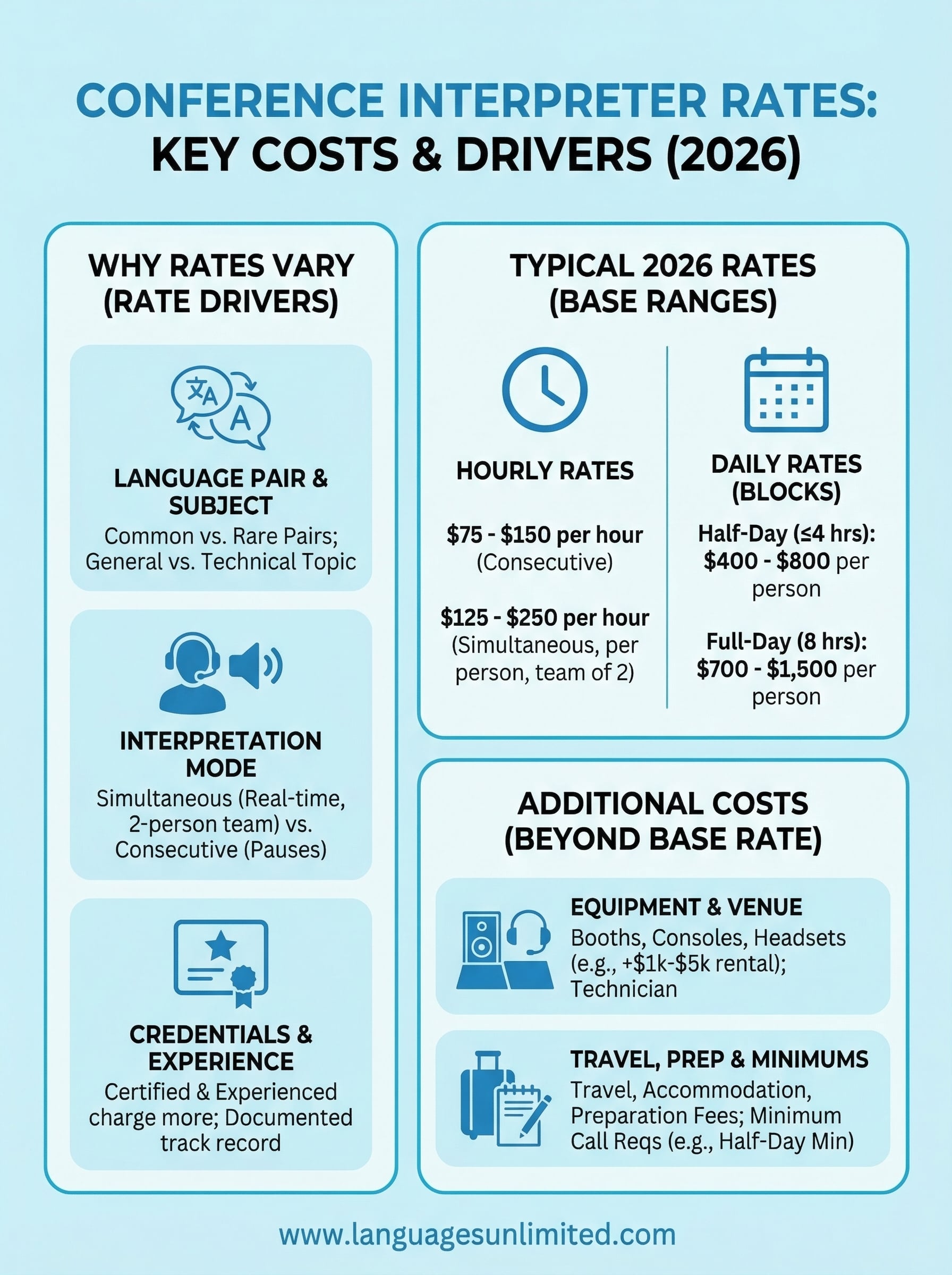
For consecutive interpretation, you can expect to pay $75 to $150 per hour for common language pairs like English-Spanish or English-French. Simultaneous interpretation, which is more cognitively demanding and often requires a two-interpreter team, runs higher, typically between $125 and $250 per hour per interpreter. Rare language pairs or highly technical subjects can push hourly rates well above those ceilings.
For simultaneous interpretation, always budget for two interpreters per language, since professional standards require them to rotate every 20 to 30 minutes to maintain accuracy.
Half-day and full-day rates
Most professional interpreters price their services in half-day or full-day blocks rather than strictly by the hour, since travel and preparation time factor into their availability. A half-day rate (up to four hours) typically runs $400 to $800 per interpreter for common language pairs. Full-day rates generally range from $700 to $1,500, with simultaneous interpreters on the higher end of that scale. Building your budget around day rates rather than hourly figures usually gives you a more accurate project total.
What affects the quote and total project cost
When you request a quote for conference interpretation, the baseline rate is only one part of the total. Several additional cost factors layer on top of the per-hour or per-day rate, and missing them is the most common reason event budgets come up short. Understanding these line items upfront lets you compare proposals on equal footing.
Equipment and venue setup
Simultaneous interpretation equipment is a significant budget item in its own right. Sound booths, interpreter consoles, receiver units, and wireless headsets for attendees all carry rental fees that run independently of interpreter fees. For a mid-sized conference, equipment rental alone can add $1,000 to $5,000 to your total cost depending on the number of attendees and language channels required. Some providers bundle equipment and interpreters into a single package; others bill them separately.
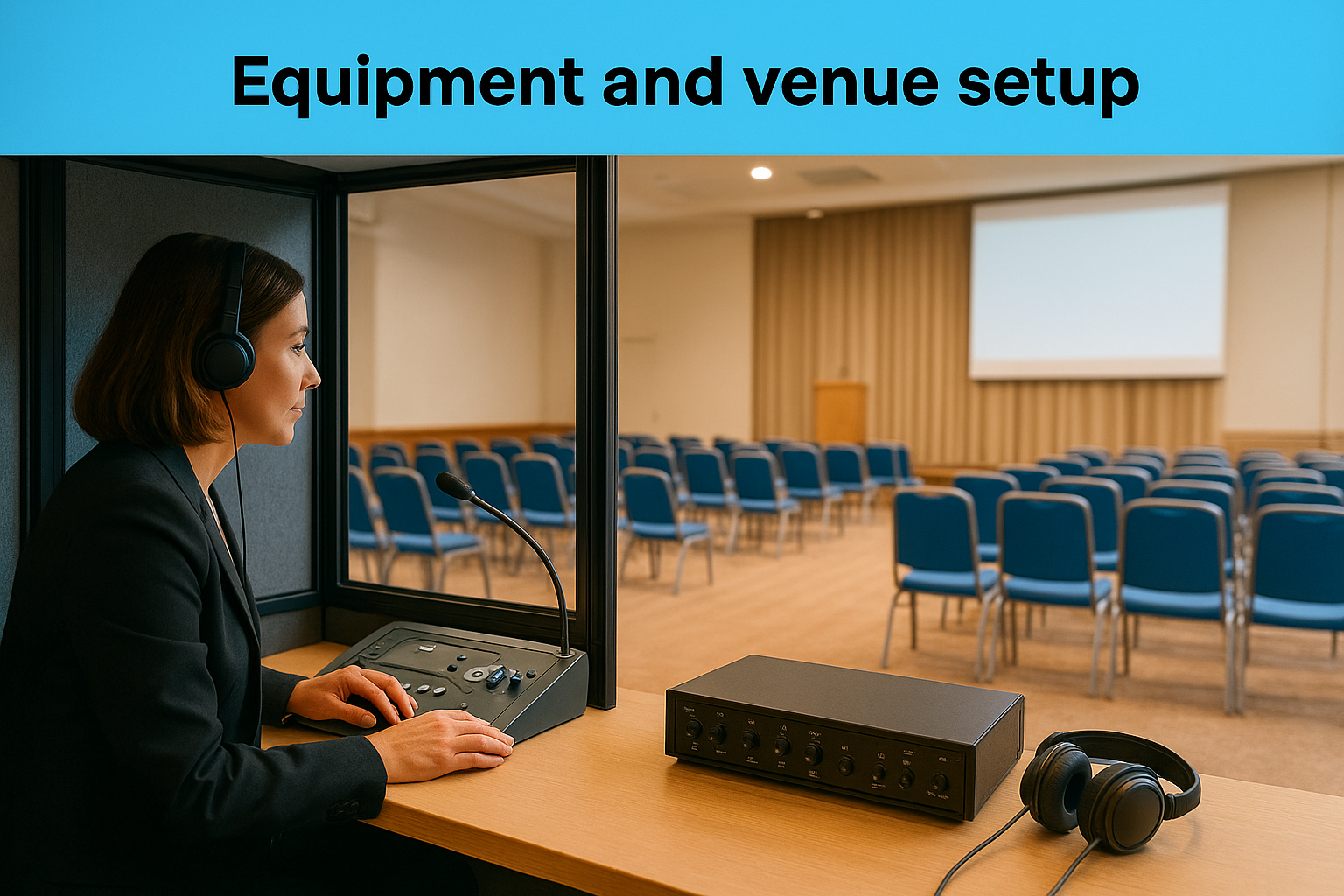
Always confirm whether your quote includes equipment, a technician to operate the system, and delivery fees before you sign off on any proposal.
Travel, preparation, and minimum call requirements
If your event is not in a major metro area, travel time and accommodation costs for interpreters are typically billed on top of their professional rate. Most experienced conference interpreters also charge a preparation fee when events involve dense technical material, since reviewing glossaries and briefing documents takes time. Many professionals also enforce minimum call requirements, often a half-day minimum even for short sessions, so factor that into your per-event calculation.
How to estimate and request a quote
Getting an accurate quote starts before you contact any provider. The more detail you give an interpretation service upfront, the more precise and comparable your estimates will be. Providers price conference interpreter rates based on specifics, so vague requests tend to produce vague numbers that don’t hold up once you confirm event details.
Build a project brief first
Before you reach out, gather the basic facts about your event in one place. A clear brief removes back-and-forth and speeds up the quoting process considerably.
Your brief should include:
- Event date, location, and total duration (including setup time if relevant)
- Number of languages and direction of interpretation required
- Interpretation mode (simultaneous, consecutive, or remote)
- Subject matter and technical complexity
- Expected number of attendees per language channel
- Whether you need equipment provided or will source it separately
The more complete your brief, the fewer surprises appear in the final invoice.
What to include in your request
When you contact a provider, ask them to itemize the quote so you can see interpreter fees, equipment costs, and any travel or preparation charges listed separately. This makes it straightforward to compare proposals from multiple vendors side by side.
Also confirm cancellation and rescheduling terms before you sign anything. Interpreter availability is often locked in well ahead of event dates, and last-minute changes typically carry fees that can affect your total budget.
Rate formats and extras to budget for
When you’re comparing conference interpreter rates, the pricing format matters as much as the number itself. Providers structure their fees in different ways, and knowing which format applies to your quote keeps your total from shifting unexpectedly when the final invoice arrives.
Day rate vs. per-session pricing
Most professional conference interpreters prefer full-day or half-day blocks over strict hourly billing. A day rate gives the interpreter a guaranteed minimum for their time and travel, regardless of whether your session runs short. Some providers offer per-session pricing for shorter or informal events, which can work in your favor if you only need a couple of hours of coverage, but always check whether minimums apply before assuming the lower rate holds.
Always clarify whether the quoted rate covers a four-hour half-day or an eight-hour full day so there are no billing surprises after the event.
Common add-ons that expand your budget
Several line items appear on final invoices that don’t always show up in initial estimates. Rush fees apply when you book interpreters on short notice, and glossary and materials preparation is often billed separately when your subject involves dense technical or legal content.
Common extras to account for in your final budget:
- Rush booking fees for requests within one to two weeks of the event
- Travel reimbursement and per diem for out-of-town assignments
- Preparation time charges for specialized subject matter
- Fees for session overruns beyond the agreed block
Wrap-up
Conference interpreter rates in 2026 follow clear patterns once you understand what drives them. Language pair, interpretation mode, interpreter credentials, and event logistics each play a role in the final number, and budgeting accurately means accounting for equipment, preparation, and travel alongside the base rate. The ranges covered in this article give you a realistic starting point, whether you’re planning a half-day corporate meeting or a multi-language international conference.
Your best next step is to request an itemized quote with your full event details in hand. Vague requests produce vague estimates, so build your project brief first, confirm what’s included in each line item, and compare proposals on equal terms. If you’re ready to move forward or want expert guidance before committing to a budget, contact the Languages Unlimited team to discuss your event and get a detailed, accurate quote for professional conference interpretation services.