



A mistranslated word in a legal document can invalidate a contract, delay an immigration case, or cause a court filing to be rejected outright. When the stakes are this high, certified legal translation services become essential, not optional. Courts, government agencies, and immigration authorities require translations that meet strict accuracy and authentication standards.
So what exactly makes a translation "certified," and how do you know if you’re getting a service that will actually be accepted? These are questions we answer daily at Languages Unlimited, where we’ve provided USCIS-approved translations for legal professionals, businesses, and individuals since 1994. Our ATA membership and GSA contract holder status reflect the quality standards courts and agencies expect.
This guide breaks down what certified legal translation services include, when you need them, what they cost, and how to choose a provider that meets official requirements. By the end, you’ll know exactly what to look for and what to expect from the process.
What certified legal translation services include
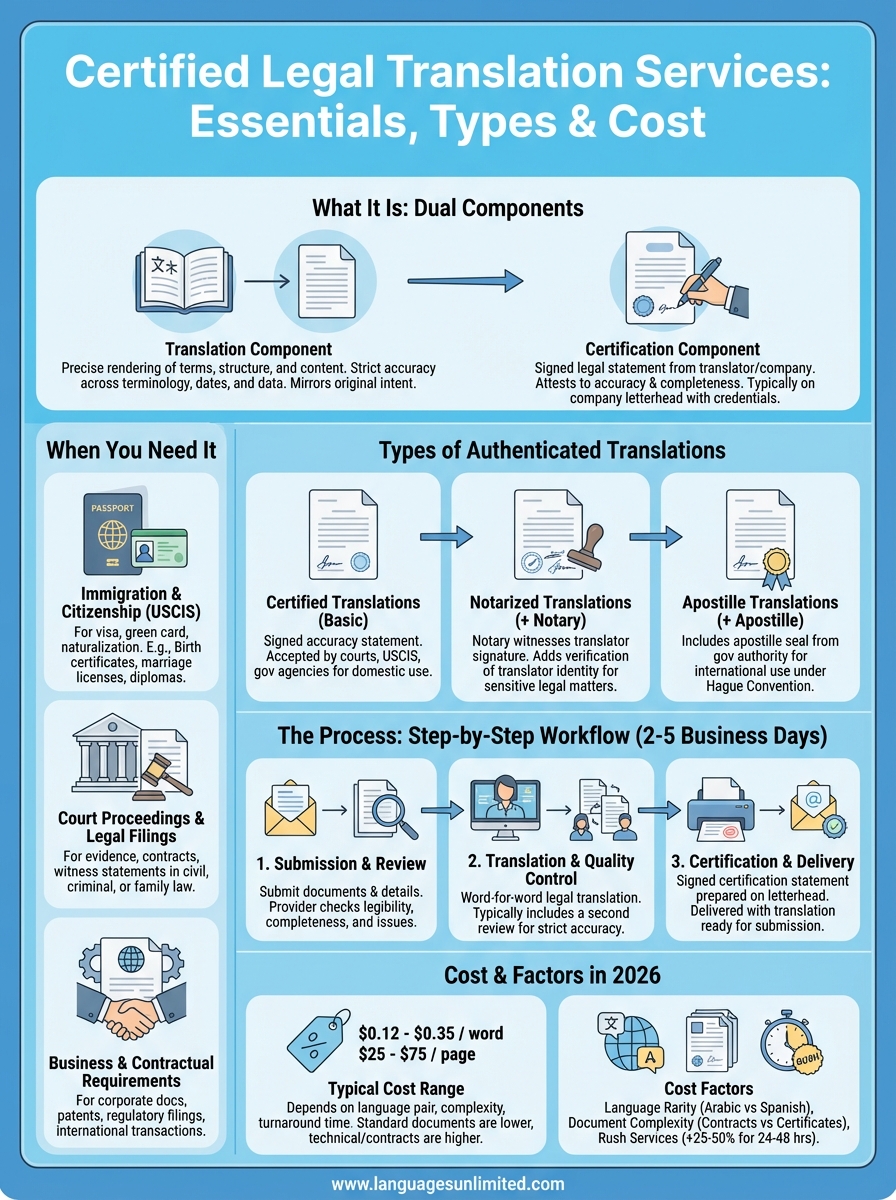
Certified legal translation services combine accurate document translation with official authentication that courts and government agencies accept. The certification isn’t just a stamp or formality. It’s a formal legal statement from the translator or translation company attesting to the accuracy and completeness of the translated work. This dual component of translation plus certification sets these services apart from standard translation work you might use for business communications or personal documents.
The translation component
Your legal documents require precise rendering of every term, clause, and formatting element into the target language. Professional translators who handle legal work understand that even minor errors in contracts, court filings, or immigration papers can change contractual obligations or cause official submissions to be rejected. They maintain strict accuracy across legal terminology, numerical data, dates, names, and document structure. The translated version must mirror the original in both content and legal intent, preserving the exact meaning that makes the document valid in its new language context.
"A certified translation must be a complete and accurate representation of the original document without additions, omissions, or alterations."
The certification component
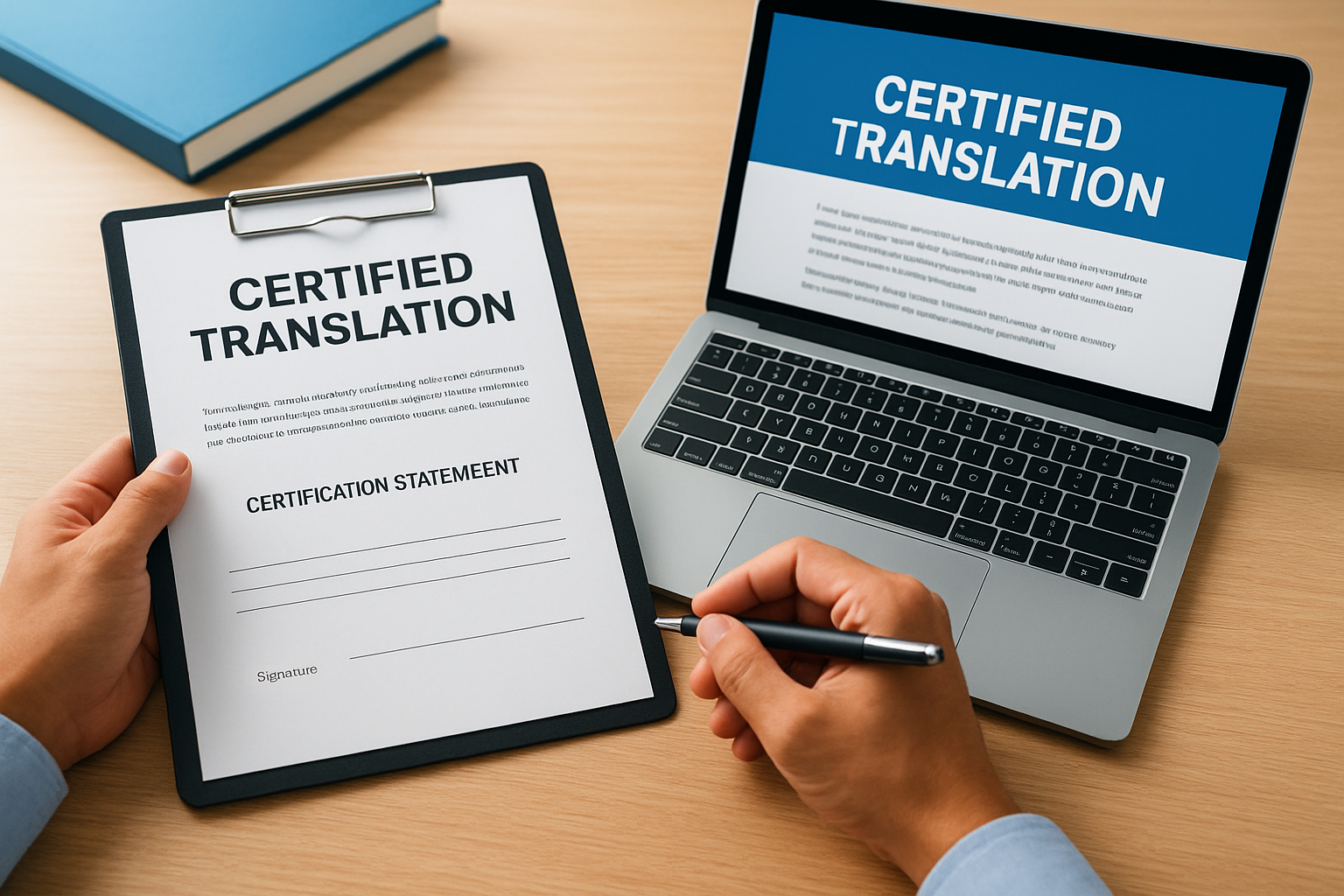
The certification itself includes a signed statement from the translator or translation company declaring the translation’s accuracy and completeness. This statement typically appears on company letterhead and includes the translator’s credentials, contact information, and a formal attestation that they’re competent in both the source and target languages.
The certification document lists the translated materials, confirms no content was altered or omitted, and provides the date of translation. Some jurisdictions also require the translator’s signature to be notarized, adding another layer of authentication. This certification becomes part of your submission package, giving officials the accountability trail they need to accept your translated materials.
When you need certified legal translations
You need certified legal translation services when official institutions require proof that your translated documents are accurate and complete. Courts, immigration authorities, government agencies, and regulatory bodies reject standard translations because they lack the formal attestation these entities require. The certification serves as a legal guarantee that the translation faithfully represents the original document, making it admissible in formal proceedings and official applications.
Immigration and citizenship applications
USCIS and immigration authorities require certified translations for all foreign language documents submitted with visa applications, green card petitions, naturalization requests, and asylum cases. Birth certificates, marriage licenses, divorce decrees, academic diplomas, and police records all need certified English translations to accompany your application. Without proper certification, your application gets delayed or rejected outright, regardless of how accurate the translation might be.
Court proceedings and legal filings
Courts mandate certified translations for any foreign language evidence, witness statements, contracts, or legal documents you submit in litigation. This includes criminal proceedings, civil lawsuits, family court matters, and arbitration hearings. Judges and court clerks need verification that translations are accurate before accepting them into the record, protecting the integrity of legal proceedings.
Business and contractual requirements
International business transactions often require certified translations of corporate documents, contracts, patents, and regulatory filings. You’ll need these when registering foreign companies domestically, filing intellectual property applications, or submitting documents to regulatory agencies that oversee international trade and commerce.
"Immigration authorities and courts reject over 30% of uncertified translations, causing costly delays in time-sensitive legal matters."
Certified vs notarized vs apostille translations
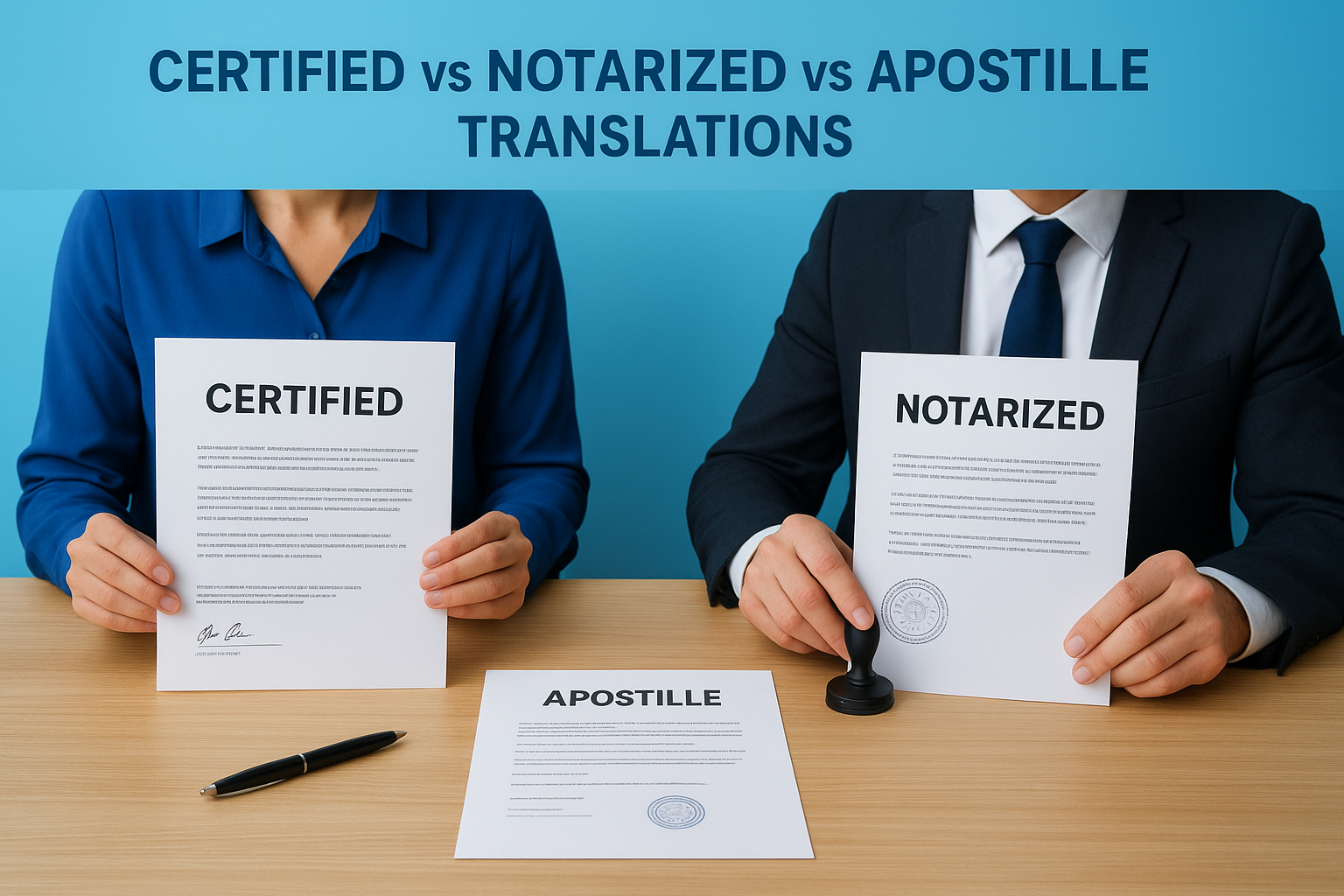
People often confuse these three types of authenticated translations because they all involve official verification, but they serve different purposes and offer distinct levels of authentication. Understanding which type you need prevents wasted time and money on the wrong service. The authentication level you require depends on where and how you’ll use your translated documents.
Certified translations
A certified translation includes a signed statement from the translator or translation company attesting to the accuracy and completeness of the work. This certification appears on company letterhead and provides the translator’s credentials and contact information. Courts, immigration authorities, and government agencies typically accept certified translations without additional authentication steps.
Notarized translations
Notarized translations add another layer by having a notary public witness the translator’s signature on the certification statement. The notary verifies the translator’s identity and adds their official seal, creating a legally recognized document. Some jurisdictions require this extra step, particularly for sensitive legal matters or when documents will be used in multiple legal contexts.
"Apostille translations are required when your documents cross international borders under the Hague Convention, while certified translations often suffice for domestic use."
Apostille translations
Apostille translations include certification plus an apostille seal from a designated government authority, validating the document for international use between countries that signed the Hague Apostille Convention. You need apostille translations when submitting documents to foreign governments or international organizations that require this highest level of authentication.
How the certified translation process works
Understanding the step-by-step process helps you know what to expect when you order certified legal translation services and ensures you provide the right materials upfront. The workflow typically takes between two to five business days for standard documents, though expedited services are available when you face tight deadlines. Professional translation companies follow a structured approach that balances accuracy with official authentication requirements.
Document submission and review
You start by submitting your original documents along with details about where you’ll use the translations. The translation company reviews your materials to verify they’re legible, complete, and suitable for certification. They’ll identify any formatting challenges or unclear sections that might require clarification before translation begins.
Translation and quality control
Qualified translators with legal expertise in both languages translate your documents word-for-word, preserving the original formatting and structure. Most professional services include a second review by another translator to catch errors and verify accuracy. This quality control step prevents the mistakes that could invalidate your submission.
"Professional translation companies typically use a two-step review process to ensure accuracy before adding the certification statement."
Certification and delivery
The translator or company prepares a signed certification statement on letterhead, attesting to the translation’s accuracy and completeness. You receive both the translated document and certification together, ready for submission to courts, immigration authorities, or other official bodies.
What certified legal translations cost in 2026
Certified legal translation services typically cost between $0.12 and $0.35 per word depending on the language pair, document complexity, and turnaround time you need. Standard documents like birth certificates or marriage licenses fall on the lower end, while complex legal contracts or technical immigration documents command higher rates. Most providers offer per-page pricing as an alternative, ranging from $25 to $75 per page for common language pairs like Spanish, French, or German to English.
Factors that affect your translation costs
Language rarity drives the biggest price variations. You’ll pay less for Spanish or French translations than for languages with fewer available translators like Arabic, Mandarin, or Russian. Document complexity matters too, since contracts with dense legal terminology require specialized expertise that increases rates. Rush services add 25% to 50% to your base cost when you need translations within 24 to 48 hours.
"Document length, language pair, and turnaround time combine to determine your final cost, with rush fees adding up to 50% for same-day or next-day delivery."
Volume discounts apply when you submit multiple documents at once, potentially reducing per-page costs by 15% to 30% for projects over ten pages.
Next steps
You now understand what certified legal translation services provide, when you need them, and what they cost. The next step depends on your specific situation. Gather your original documents and determine where you’ll submit them, since different institutions have varying authentication requirements. Check whether you need basic certification, notarization, or apostille services before requesting quotes.
Compare providers based on their credentials and experience with your document type, not just price. Look for translation companies with ATA membership, USCIS approval, or government contract holder status, since these credentials indicate they meet official standards courts and agencies accept. Ask about turnaround times, quality control processes, and whether they offer customer support if questions arise during your submission.
Ready to get your legal documents certified? Languages Unlimited has provided USCIS-approved translations since 1994, backed by our ATA membership and GSA contract holder status. Contact us to discuss your specific requirements and receive an accurate quote for your project.