



Medical interpreters bridge critical communication gaps between healthcare providers and patients with limited English proficiency. To work in this field professionally, earning a CCHI medical interpreter certification demonstrates your competency and commitment to industry-recognized standards. The Certification Commission for Healthcare Interpreters (CCHI) offers credentials that many hospitals, clinics, and healthcare systems require or prefer when hiring interpreters.
If you’re considering this career path, or looking to formalize your existing skills, you likely have questions about eligibility, exam formats, costs, and how CCHI credentials compare to alternatives like the NBCMI certification. This guide breaks down everything you need to know to pursue CCHI certification, from initial requirements through the examination process.
At Languages Unlimited, we work with thousands of professional interpreters across the country, many of whom hold CCHI credentials. We understand what it takes to succeed in medical interpreting and the value that proper certification brings to both interpreters and the organizations they serve.
What CCHI certification is and what it proves
The Certification Commission for Healthcare Interpreters is an independent nonprofit organization that validates the skills and knowledge of medical interpreters through rigorous testing. When you earn a CCHI medical interpreter certification, you prove that you meet nationally recognized competency standards for interpreting in healthcare settings. This credential signals to employers that you understand medical terminology, ethical guidelines, and the interpreting techniques required to facilitate accurate patient-provider communication.
The core credential options
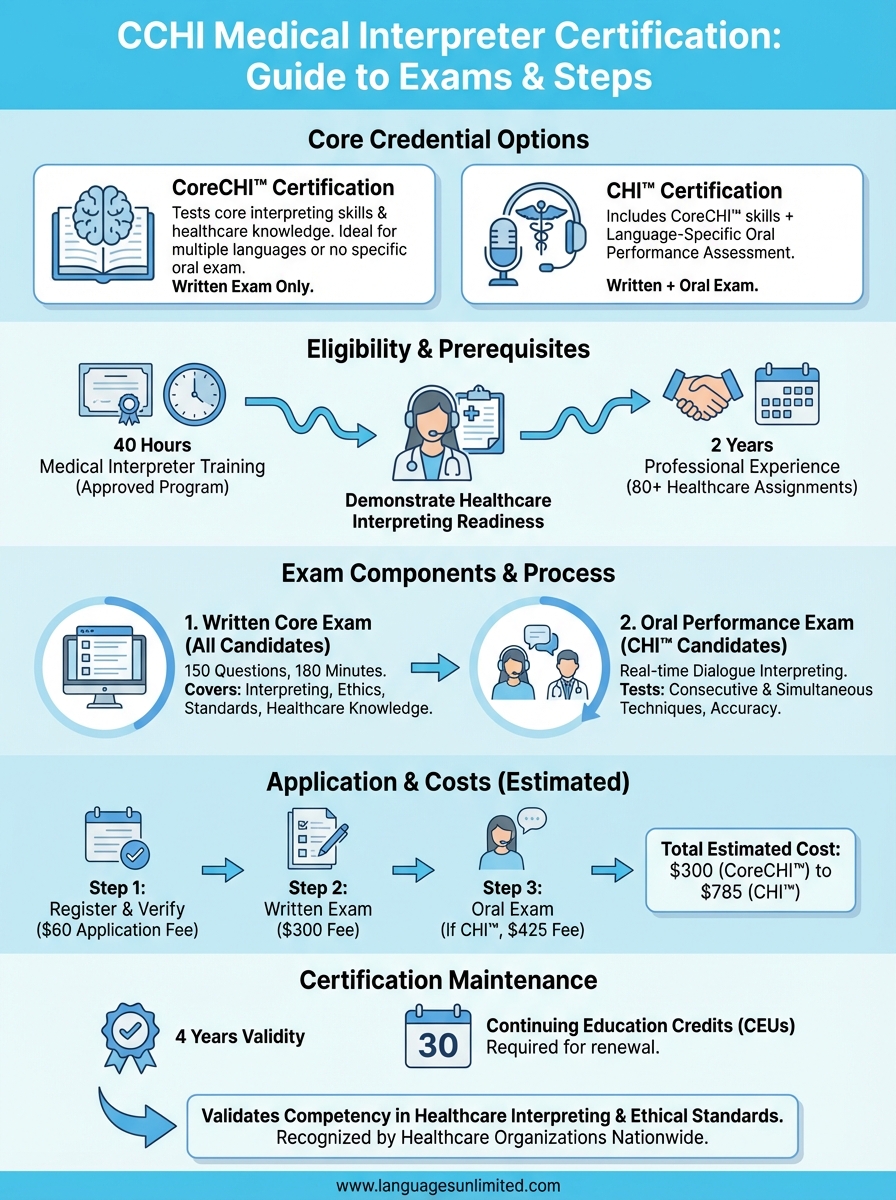
CCHI offers two distinct certification paths depending on your language proficiency and professional goals. The CoreCHI™ certification tests your core interpreting skills and healthcare knowledge without requiring language-specific assessment, making it ideal if you work in multiple languages or in languages where CCHI doesn’t yet offer full certification exams. The CHI™ (Certified Healthcare Interpreter) certification includes both the core skills exam and a language-specific oral performance assessment, currently available in languages like Spanish, Arabic, Mandarin, Russian, and Vietnamese.
Both credentials require you to demonstrate mastery of medical interpreting protocols, not just basic language fluency.
What certification demonstrates to employers
Your CCHI credential shows hiring managers that you’ve passed standardized tests measuring your interpreting competence and ethical decision-making in healthcare contexts. Hospitals and clinics increasingly require this certification for employment or credentialing purposes, as it provides third-party verification of your abilities. The certification proves you understand HIPAA compliance, informed consent protocols, and how to maintain professional boundaries while interpreting sensitive medical information. Organizations that receive federal funding or serve diverse patient populations often mandate CCHI credentials to ensure quality care and reduce miscommunication risks during critical medical encounters.
Who can apply and what you need first
You don’t need a college degree to pursue CCHI medical interpreter certification, but you must meet specific prerequisites that demonstrate your readiness for professional healthcare interpreting. The eligibility requirements vary slightly depending on which credential you pursue, but all applicants need documented training in medical interpreting or substantial professional experience in healthcare settings. CCHI designed these prerequisites to ensure that candidates understand the healthcare environment before attempting the certification exams.
Education and training pathways
CCHI accepts several pathways to meet the training requirement for certification. You can complete 40 hours of medical interpreter training from an approved program, which covers medical terminology, interpreting techniques, and professional ethics. Alternatively, you qualify through two years of professional interpreting experience with at least 80 assignments in healthcare settings, supported by verification letters from employers or clients. Some applicants combine shorter training programs with documented work experience to meet the threshold.
Your training must specifically address healthcare interpreting, not just general language instruction or translation work.
Language proficiency standards
Beyond interpreting training, you need native or near-native fluency in both English and your target language to succeed in the CCHI certification process. The exams test complex medical concepts and terminology that require advanced vocabulary in both languages, along with the ability to convey nuanced meaning accurately under time pressure.
CCHI exams explained
The CCHI certification process includes two distinct examinations that test different aspects of your interpreting ability. You’ll take a written multiple-choice exam that assesses your knowledge of healthcare interpreting protocols, medical terminology, and ethical standards. If you pursue the full CHI™ credential rather than just CoreCHI™, you’ll also complete an oral performance exam that evaluates your real-time interpreting skills in your specific language pair.
The written core exam
Your written exam for CCHI medical interpreter certification contains 150 multiple-choice questions covering five content domains. You’ll answer questions about interpreting modes and skills, ethical standards, professional standards of practice, healthcare system knowledge, and cultural responsiveness. The exam allocates 180 minutes for completion and uses scenario-based questions that test your decision-making in realistic healthcare situations. You can take this computer-based test at authorized testing centers across the country or through remote proctoring from your home.
Passing the written exam demonstrates your theoretical knowledge before you attempt the practical oral assessment.
The oral performance exam
The oral component evaluates how you perform under actual interpreting conditions. You’ll interpret dialogues between healthcare providers and patients covering different medical scenarios and specialties, demonstrating consecutive and simultaneous interpreting techniques. The exam records your voice responses to audio prompts, which trained raters later evaluate based on standardized rubrics measuring accuracy, completeness, and professional technique.
How to get CCHI certified step by step
The path to earning your CCHI medical interpreter certification follows a structured application process that you can complete entirely online. You’ll start by creating an account through CCHI’s portal, then submit documentation proving you meet the eligibility requirements, and finally schedule your examinations. The entire process typically takes several weeks to several months depending on how quickly you gather your documents and prepare for testing, though you control the pace by choosing when to sit for each exam component.

Create your account and verify eligibility
You begin by registering through the CCHI candidate portal and uploading proof of your training or experience that meets their prerequisites. This includes certificates from approved medical interpreter training programs, employer verification letters for your work history, or transcripts if you completed relevant coursework. CCHI staff review your submitted documents within two to three weeks and notify you once they approve your eligibility to test. If your documentation doesn’t meet requirements, they’ll explain what additional materials you need to provide before moving forward.
Schedule and prepare for your exams
Once CCHI approves your application, you can schedule your written exam through their testing vendor’s website, choosing either a testing center location or remote proctoring option. After passing the written component, you’ll receive instructions to register for the oral performance exam if you’re pursuing full CHI™ certification rather than CoreCHI™. You pay separate fees at each stage and can space out your exam attempts based on your preparation timeline and personal schedule.
Each exam component requires separate registration and payment, giving you flexibility in timing.
Costs, prep, retakes, and keeping your credential
Pursuing your CCHI medical interpreter certification requires financial investment and ongoing commitment beyond just passing the exams. You need to budget for application fees, testing costs, study materials, and future renewal expenses. Understanding these costs upfront helps you plan your certification timeline and ensures you maintain your credential once earned.
What you’ll pay for certification
The written core exam costs $300, while the oral performance exam adds another $425 if you pursue full CHI™ certification rather than CoreCHI™ alone. You also pay a $60 application fee when you first submit your eligibility documents through the CCHI portal. If you need to retake either exam after an unsuccessful attempt, you’ll pay the full exam fee again with no discount for repeat testing.
Budget at least $785 total if you’re pursuing the complete CHI™ credential with both exam components.
Preparing effectively and maintaining your credential
CCHI doesn’t require specific study materials, but you should review medical terminology resources and practice interpreting scenarios before testing. Many candidates use their original training materials or join study groups with other aspiring interpreters. Your certification remains valid for four years from the date you pass, after which you must submit 30 continuing education credits and pay a renewal fee to maintain active status.
Quick recap and next steps
Earning your CCHI medical interpreter certification requires meeting training or experience prerequisites, passing either one or two exams depending on your chosen credential, and investing between $300 and $785 in application and testing fees. The process validates your competency in medical interpreting through standardized assessments that healthcare organizations nationwide recognize and trust. Your certification remains valid for four years before you need to complete continuing education and renew.
If you’re ready to pursue your credential, start by gathering documentation of your training hours or professional experience to confirm your eligibility. Consider your budget for exam fees and preparation materials, then create your account in the CCHI portal to begin the application process. Organizations like Languages Unlimited partner with certified medical interpreters across all fifty states to provide professional language services in healthcare settings. Whether you’re working toward certification or already credentialed, contact our team to learn about opportunities with qualified interpreters in your language pair.