



When a non-English-speaking client walks into your law office or a witness takes the stand without fluency in English, clear communication becomes non-negotiable. A legal OPI service provides immediate access to qualified interpreters through a phone call, bridging language gaps in attorney-client consultations, depositions, and courtroom proceedings without delay.
For law firms and courts, the stakes are high. Miscommunication can compromise case outcomes, violate a client’s rights, or create liability issues. Over-the-phone interpretation offers a practical solution when on-site interpreters aren’t available or when you need rapid language support for less common languages.
This article explains what legal OPI service involves, how it works in practice, and what to look for in a provider. At Languages Unlimited, we’ve supported legal professionals with telephonic interpretation since 1994, connecting them with qualified interpreters across hundreds of languages for time-sensitive legal matters.
What legal OPI means in a legal setting
OPI stands for over-the-phone interpretation. In a legal context, a legal OPI service connects you to trained interpreters through a phone line when language barriers arise during legal proceedings or consultations. You dial a number, select your language pair, and an interpreter joins the call within seconds to minutes.
The technical setup for legal OPI
Your law firm or court facility doesn’t need specialized equipment beyond a standard phone or conference system. When you encounter a non-English speaker, you place a call to your OPI provider, request the target language, and receive an interpreter ID or confirmation number for your records. The interpreter stays on the line for the duration of your conversation, whether that’s five minutes or several hours.
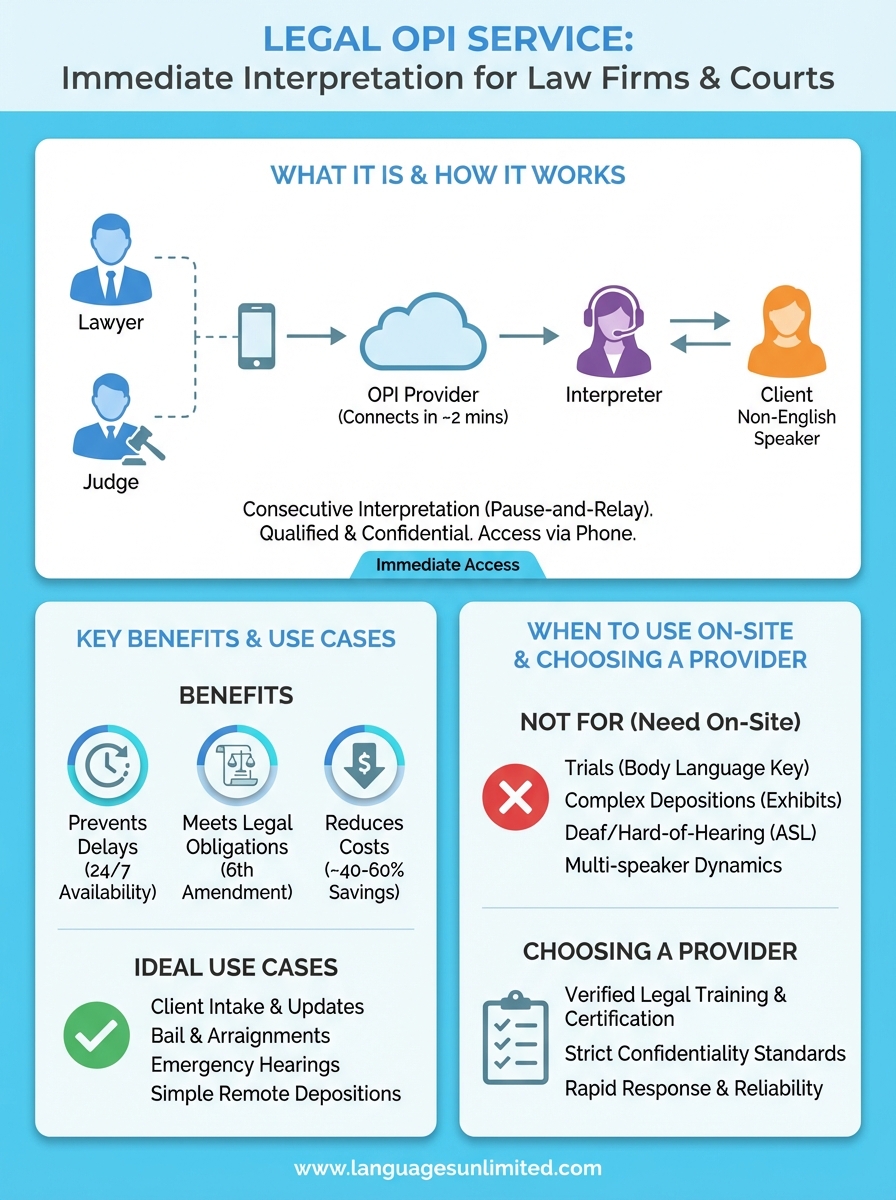
Legal OPI delivers qualified interpreters to your phone line in under two minutes for most major languages.
Most providers offer consecutive interpretation through OPI, where speakers pause after sentences or thoughts to allow the interpreter time to relay the message. You won’t get simultaneous interpretation (where the interpreter speaks over the original speaker) through standard phone lines due to audio limitations. Your provider assigns interpreters who understand legal terminology and maintain confidentiality standards required in attorney-client communications.
Common legal scenarios requiring OPI
Law firms use telephonic interpretation for initial client intake calls, case updates, and settlement discussions. Courts rely on OPI when physical interpreters aren’t available for arraignments, bail hearings, or emergency proceedings. You might also use OPI during depositions, witness prep sessions, or when reviewing documents with clients who need immediate clarification in their native language.
Why legal OPI matters for law firms and courts
Legal proceedings cannot wait for language barriers to resolve themselves. A legal OPI service gives you immediate access to qualified interpreters when on-site professionals are unavailable, preventing case delays and protecting your clients’ constitutional rights to understand proceedings fully.
Meeting constitutional and ethical obligations
Courts must provide competent interpretation under the Sixth Amendment and Title VI of the Civil Rights Act. Your law firm faces similar ethical duties to ensure effective communication with clients who speak limited English. OPI services help you meet these obligations without the scheduling challenges or costs of arranging on-site interpreters for every phone consultation or brief court appearance.
Reducing costs while maintaining quality
On-site interpreters charge travel fees, minimum hourly rates, and require advance booking. OPI eliminates these expenses by charging only for active interpretation time, often in per-minute increments. You save money on routine calls while reserving on-site interpreters for complex trials or depositions where physical presence adds value. The service also gives you access to rare language specialists who may not be locally available.
Legal OPI services reduce interpretation costs by 40-60% compared to on-site options for routine legal communications.
How legal OPI works during calls and proceedings
The process starts when you dial your provider’s access number and enter your account credentials or conference code. You specify the language pair you need, and the system connects you to an available interpreter within one to two minutes for common languages. The interpreter verifies your identity, receives context about the call type, and joins your conversation without needing physical presence in your office or courtroom.

Setting up the three-way call
Your receptionist or clerk initiates the connection before transferring the call to the attorney or judge. You explain the call purpose to the interpreter (client intake, witness interview, hearing), which helps them prepare mentally for legal terminology. The interpreter stays muted until needed, then provides consecutive interpretation by waiting for natural pauses in speech before relaying messages between parties.
Professional legal OPI interpreters maintain confidentiality equivalent to attorney-client privilege throughout all proceedings.
Managing the interpretation flow
You speak in short segments rather than lengthy monologues. After each thought or sentence, you pause to let the interpreter convey your message. Your client responds in their native language, and the interpreter translates back to you. This back-and-forth rhythm requires patience but ensures accuracy over speed, protecting both parties from misunderstandings that could jeopardize case outcomes.
Where legal OPI fits best and where it does not
A legal OPI service excels in specific situations while falling short in others. You get the best results when you need quick language access for routine communications, but certain proceedings demand physical interpreters who can read body language and manage complex courtroom dynamics.

Ideal use cases for legal OPI
Phone interpretation works best for client intake calls, brief status updates, and emergency hearings where time constraints prevent scheduling on-site interpreters. You’ll find it effective during bail hearings, arraignments, and preliminary motions where proceedings follow predictable formats. Remote depositions also benefit from OPI when video isn’t required and the testimony involves straightforward questions and answers.
Legal OPI handles 80% of routine legal communications without requiring physical interpreter presence.
When you need physical interpreters instead
Trials require on-site interpreters who can interpret witness expressions and manage multiple speakers during heated exchanges. Complex depositions with technical exhibits, charts, or documents need interpreters who can see materials and point to specific items. You also need physical presence when interpreting for deaf or hard-of-hearing clients who rely on sign language, or when courtroom dynamics involve multiple parties speaking simultaneously.
How to choose a legal OPI provider and set rules
Your choice of a legal OPI service determines whether you get qualified interpreters or undertrained generalists who miss legal terminology. Start by verifying that providers maintain rosters of interpreters with legal training and require confidentiality agreements that match attorney-client privilege standards. Check response times for your most common languages and ask about backup systems when high-demand languages face interpreter shortages.
Vetting provider credentials and interpreter qualifications
Request proof of professional certifications from organizations like the National Association of Judiciary Interpreters and Translators or state court certification programs. Your provider should track each interpreter’s background, test their legal terminology knowledge, and maintain quality assurance records. Ask how they handle rare languages and whether they guarantee interpreter availability within specific timeframes for emergency situations.
A qualified legal OPI provider maintains interpreter rosters with verified legal training and court certification credentials.
Establishing internal protocols for OPI use
Set clear guidelines for when staff should use OPI versus requesting on-site interpreters. Train your team to brief interpreters on case context without revealing privileged information before your attorney joins the call. Document each OPI session with interpreter IDs, call duration, and language pairs for billing verification and compliance audits.
Next steps
Your law firm or court needs reliable language access to serve non-English speakers effectively and meet legal obligations. A legal opi service provides that access within minutes, connecting you to qualified interpreters whenever language barriers arise during consultations, hearings, or emergency proceedings.
Start by evaluating your current interpretation needs and identifying situations where phone interpretation could replace costly on-site services. Review potential providers for legal credentials, interpreter qualifications, and response times that match your operational requirements. Set internal protocols that define when your team should use OPI versus requesting physical interpreters, and train staff on proper briefing procedures to protect client confidentiality.
Languages Unlimited delivers professional telephonic interpretation with legal-trained interpreters available 24/7 across hundreds of languages. Contact our team to discuss your firm’s specific language needs and set up a legal OPI account that ensures you never let language barriers compromise case outcomes.