



You finish interpreting a long consecutive passage and realize you’ve forgotten a crucial detail. The speaker mentioned three specific dates, but you only captured two in your memory. Your notes look like a jumbled mess of random words that don’t help reconstruct the message. Sound familiar? Without a solid note taking for consecutive interpreting system, even experienced interpreters struggle to retain accuracy when messages extend beyond a few sentences.
The solution isn’t writing everything down. It’s developing a structured note-taking method that captures meaning, not just words. You need a system that uses symbols, abbreviations, and spatial organization to record the essence of a message while your brain focuses on listening and analysis.
This guide walks you through building that system from scratch. You’ll learn how to set up your physical toolkit, master proven note-taking structures and symbols, and develop daily practice routines that make note-taking automatic. We’ll also cover specific strategies for legal and medical interpreting contexts where accuracy matters most. By the end, you’ll have a practical framework that transforms your consecutive interpreting performance.
What is note taking in consecutive interpreting
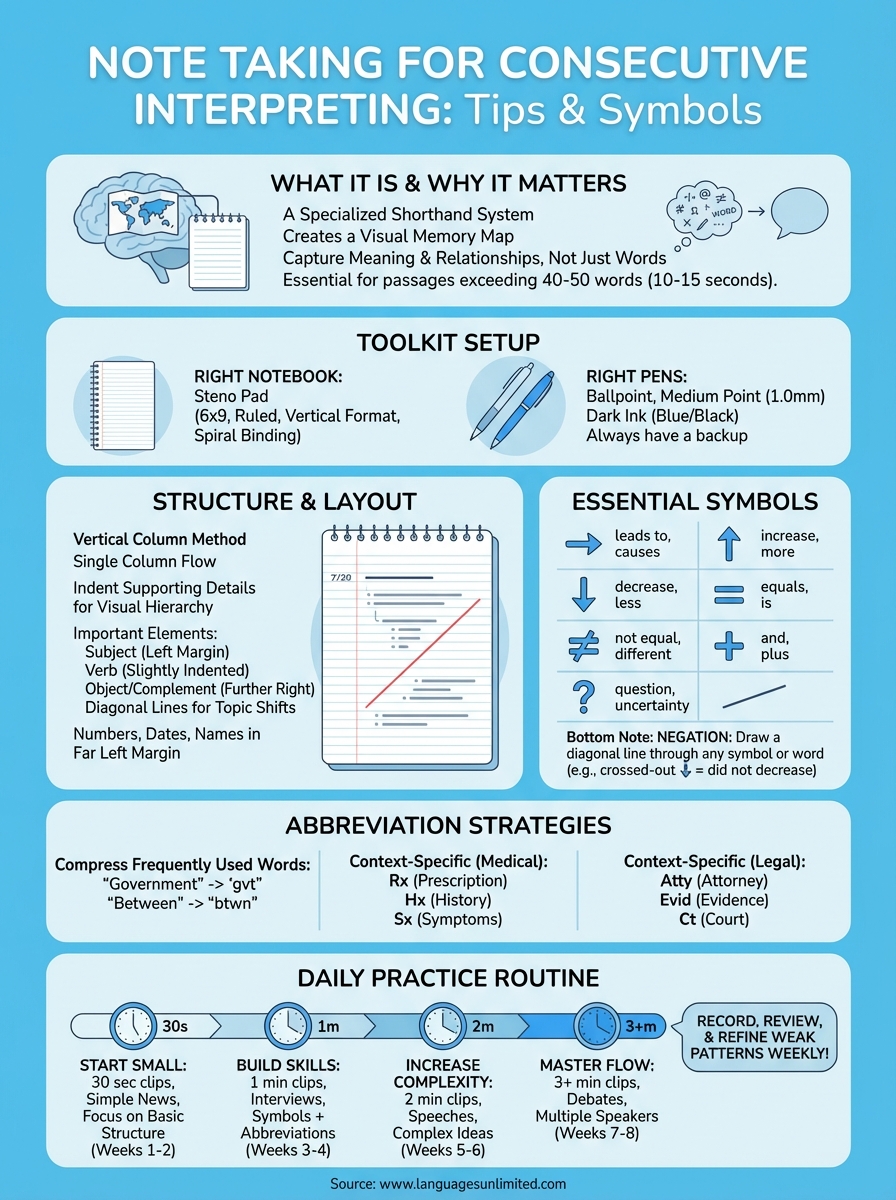
Note taking for consecutive interpreting is a specialized shorthand system that helps you capture the structure and meaning of a message while the speaker talks. You’re not transcribing every word. Instead, you create a visual map that triggers your memory when you deliver the interpretation after the speaker finishes.

The core purpose of interpreter notes
Your notes serve as memory anchors for information you might otherwise forget during longer passages. They capture key elements like numbers, names, logical connections, and the sequence of ideas. Research shows interpreters can reliably hold about 40-50 words in working memory, which equals roughly 10-15 seconds of speech. Anything beyond that needs support from notes.
Effective notes capture meaning and relationships between ideas, not isolated words.
Professional interpreters typically use a combination of source language words, target language words, symbols, and abbreviations arranged in a specific spatial layout. The system you develop becomes personal to you, though it follows universal principles about how to organize information on the page. Your notes should allow you to reconstruct the complete message accurately even several minutes after the speaker finishes talking.
Step 1. Set up your note taking toolkit
Your physical tools directly impact the quality of your notes during consecutive interpreting. The right setup lets you capture information quickly without fumbling with materials while the speaker talks. Start by choosing tools that feel comfortable and allow smooth, uninterrupted writing throughout the interpretation session.
Choose the right notebook format
Steno pads work best for note taking for consecutive interpreting because their vertical format matches the natural flow of speech. You write down the page in a single column, which creates a clear visual hierarchy of ideas as they unfold chronologically. The spiral binding at the top keeps pages secure while allowing you to flip them quickly.

Look for notebooks with these specifications:
- 6 x 9 inch size (standard steno pad dimensions)
- Ruled lines to keep your writing straight and organized
- 80-100 sheets so you don’t run out during long assignments
- Stiff backing that provides a firm writing surface
Some interpreters prefer letter-sized notepads split into two vertical columns, giving you space to separate different speakers or topics. Avoid small pocket notebooks because they limit your writing space and force cramped notes.
Select your writing instruments
Ballpoint pens give you the most reliable performance for consecutive interpreting notes. They write smoothly on various paper types, don’t smudge, and work consistently without requiring pressure adjustments. Choose medium point pens (1.0mm) that create visible lines without bleeding through the paper.
Keep at least two identical pens in your toolkit so you never lose time searching for a backup. Blue or black ink works better than lighter colors because your notes stay readable even in dim lighting conditions.
Step 2. Learn structure, symbols, and abbreviations
Your note taking for consecutive interpreting needs a consistent visual structure that your brain can process instantly. The foundation is the vertical column method, where you write down the page in one continuous flow that mirrors the speaker’s chronological progression. This section teaches you the core organizational principles and shorthand elements that professional interpreters rely on.
Use the vertical column structure
Write your notes in a single column down the page, starting at the top left. Each new idea begins on a new line, and you indent supporting details slightly to the right under their main point. This creates a visual hierarchy that shows relationships between concepts at a glance.

Place important elements in specific positions on each line:
- Subject at the left margin
- Verb slightly indented
- Object or complement further right
- Diagonal lines to separate distinct topics or speakers
Numbers, dates, and names go on the far left margin so they stand out immediately when you scan your notes. Use horizontal lines to mark major topic shifts or when the speaker moves to a completely different point.
Build your symbol vocabulary
Symbols replace entire words and save critical seconds during fast-paced interpretation. Start with these universal symbols that work across languages:
| Symbol | Meaning | Example Use |
|---|---|---|
| → | leads to, causes, results in | Policy → increased costs |
| ↑ | increase, more, growth | Sales ↑ 15% |
| ↓ | decrease, less, decline | Temperature ↓ quickly |
| = | equals, is, means | Success = hard work |
| ≠ | not equal, different from | Opinion ≠ fact |
| + | and, plus, positive | Benefits + challenges |
| ? | question, uncertainty | Timeline ? unclear |
Symbols work because your brain processes visual shapes faster than written words.
Negation deserves special attention. Draw a diagonal line through any word or symbol to indicate "not" or the opposite meaning. For example, a downward arrow with a line through it means "did not decrease."
Create your abbreviation system
Abbreviations compress frequently used words into two or three letters. Write the first and last letters of important words, which gives your brain enough information to reconstruct the full term later. "Government" becomes "gvt," "important" becomes "impt," and "between" becomes "btwn."
Develop context-specific abbreviations for your regular assignments. Medical interpreters might use "pt" for patient, "dx" for diagnosis, and "tx" for treatment. Legal interpreters could use "def" for defendant, "plt" for plaintiff, and "cont" for contract. Keep a reference list of your most-used abbreviations until they become automatic.
Step 3. Practice and refine your technique daily
Your note taking for consecutive interpreting improves through deliberate daily practice, not occasional study sessions. You need to train your brain to process speech, capture key elements, and organize information simultaneously. Consistent 15-minute practice sessions produce better results than sporadic hour-long attempts because they build muscle memory and pattern recognition.
Start with short practice exercises
Begin with 30-second audio clips from news broadcasts, podcasts, or online videos. Listen to the clip once, take notes using your symbols and structure, then interpret from your notes. Record your interpretation and compare it to the original for accuracy. Your notes should contain enough information to reconstruct the message without adding or omitting key details.

Use these progressive difficulty levels to build your skills:
| Week | Length | Content Type | Focus |
|---|---|---|---|
| 1-2 | 30 sec | Simple news | Basic structure |
| 3-4 | 1 min | Interviews | Symbols + abbreviations |
| 5-6 | 2 min | Speeches | Complex ideas |
| 7-8 | 3+ min | Debates | Multiple speakers |
Identify and fix weak patterns
Review your notes after each practice session to spot recurring problems. Maybe you miss numbers consistently, or your symbols become illegible when the speaker talks quickly. Write down three specific weaknesses at the end of each week and create targeted exercises to address them.
Practice the same passage multiple times using different symbol combinations until you find what works fastest. Your note-taking system evolves through experimentation, and what feels awkward initially becomes automatic after 20-30 repetitions.
Additional strategies for legal and medical settings
Legal and medical interpreting demands absolute precision because errors can have serious consequences for people’s rights, health, or safety. Your note taking for consecutive interpreting in these contexts requires specialized additions to your core system that prioritize accuracy over speed. You need domain-specific symbols and verification methods that reduce the risk of misinterpreting critical details.
Develop field-specific abbreviation sets
Medical interpreters benefit from creating standardized abbreviations for frequently used terms that appear in clinical conversations. Use "Rx" for prescription, "Hx" for history, "Sx" for symptoms, and "lab" for laboratory. Legal interpreters should develop shortcuts for procedural terms like "atty" for attorney, "tstfy" for testify, "evid" for evidence, and "ct" for court.
Build your terminology reference sheet with the 50 most common terms you encounter in your specialty. Keep this sheet in your toolkit during the first month of specialized work until these abbreviations become automatic reflexes.
Mark numbers and names with visual flags
Circle all numbers in your notes and underline proper names to make them stand out instantly when you scan your page. Legal proceedings often involve multiple parties with similar names, so develop a consistent system like "P" for plaintiff and "D" for defendant, followed by initials. Medical settings require you to distinguish between dosages, test results, and dates, so write numbers in the left margin with a box around them.
Accuracy in specialized settings depends on making critical details impossible to overlook in your notes.
Putting it all into practice
You now have a complete framework for note taking for consecutive interpreting that covers tools, structure, symbols, and practice routines. Start with your toolkit setup today, then dedicate 15 minutes each morning to practicing with short audio clips. Track your progress by recording your interpretations and comparing them against the original source material. Your note-taking system becomes automatic after 30 days of consistent practice.
Professional interpretation assignments require both strong note-taking skills and access to qualified interpreters. Whether you need consecutive interpreting for legal proceedings, medical consultations, or business meetings, Languages Unlimited connects you with experienced interpreters who have mastered these techniques across all 50 states. Contact our team to discuss your upcoming interpretation needs and language requirements.