



Your marketing campaign crushed it domestically. The messaging resonated, conversions soared, and brand recognition grew. Now you’re ready to take it global, but here’s where many companies stumble. A direct translation of your carefully crafted ad copy can fall flat, confuse audiences, or worse, offend them. That’s exactly why advertising translation services exist: to bridge the gap between your brand’s voice and international audiences who think, shop, and respond differently.
Advertising translation goes beyond word-for-word conversion. It requires understanding cultural nuances, local humor, regional preferences, and the emotional triggers that drive purchasing decisions in each market. At Languages Unlimited, we’ve worked with businesses since 1994 to help their messages land with the same punch across borders, whether that’s a tagline, a video campaign, or a full-scale product launch.
This guide breaks down what advertising translation services actually involve, how they differ from standard translation, and what to look for when choosing a provider.
Why advertising translation matters for campaigns
You can’t afford to treat international markets as afterthoughts. Your advertising budget gets wasted when messages don’t connect with local audiences, and competitors who invest in proper localization will capture the market share you’re chasing. Every campaign element, from taglines to calls-to-action, needs to resonate emotionally and culturally with the people you’re targeting, or you’re burning money on ads that fall flat.
Cultural missteps kill campaign performance
Direct translations often miss the mark because they ignore how different cultures respond to humor, color symbolism, imagery, and even product benefits. What works in one market can confuse or offend in another. For example, a casual tone that builds trust in the U.S. might seem unprofessional in Japan, while a formal approach in Brazil could distance you from potential customers. Advertising translation services address these nuances by adapting your message to match local expectations and preferences.

Poor localization doesn’t just reduce engagement. It actively damages your brand reputation in new markets.
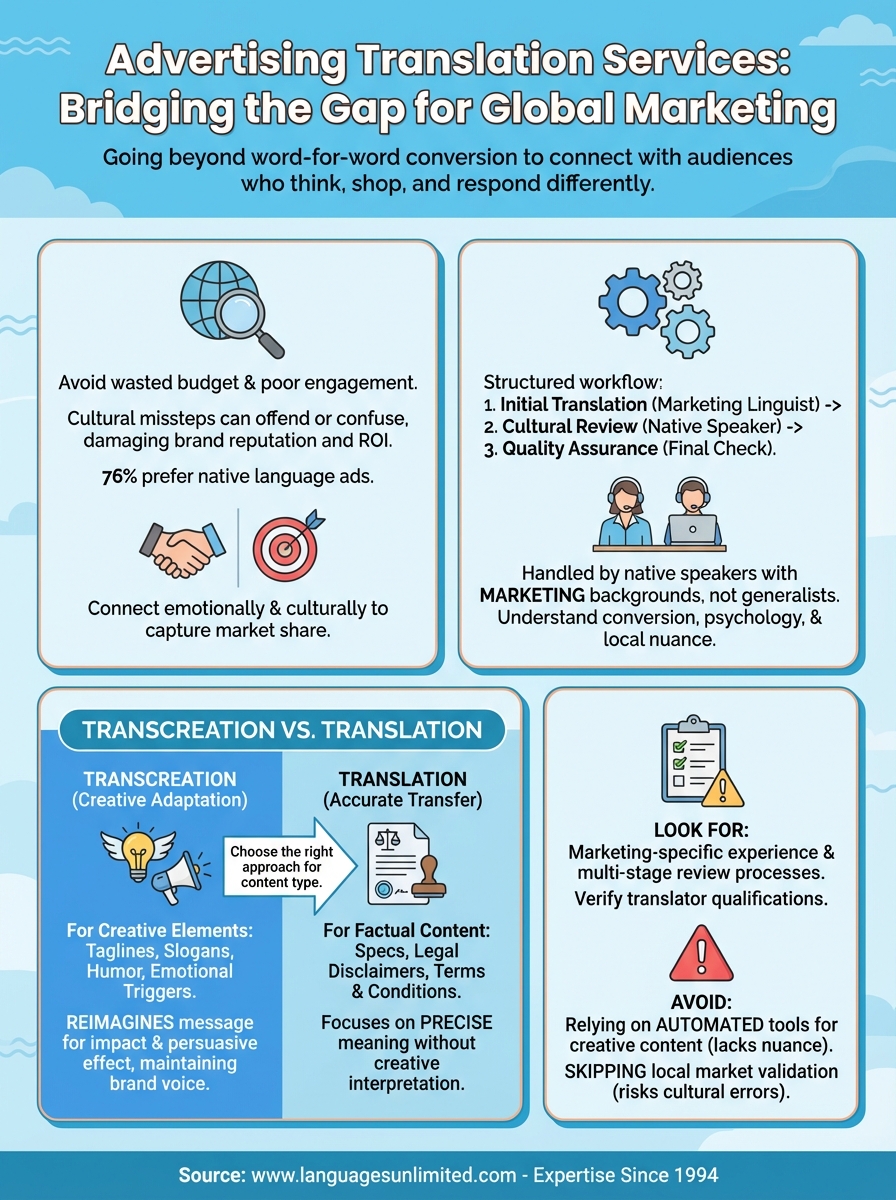
Campaign ROI suffers immediately when your translated ads don’t speak to the target audience’s values and pain points. You’ll see lower click-through rates, weaker conversion metrics, and higher customer acquisition costs compared to competitors who invested in quality translation and transcreation. Research shows that 76% of online shoppers prefer buying products with information in their native language, and that preference extends to the ads that brought them there.
The stakes get higher when you’re launching products, running seasonal promotions, or building long-term brand recognition internationally. A single poorly translated campaign can set back your market entry by months and cost you credibility that takes years to rebuild.
How advertising translation services work
Professional advertising translation involves multiple review stages and specialized expertise. You submit your marketing materials, whether that’s ad copy, video scripts, banner text, or campaign assets, and the provider assigns translators who understand both the language and marketing principles. Each project goes through translation, cultural adaptation, and quality review to ensure your message maintains its persuasive power across markets.
The translation and review process
Your content enters a structured workflow that typically includes initial translation by a marketing-focused linguist, cultural review by a native speaker from the target market, and final quality assurance checks. This multi-layer approach catches issues that would slip through automated tools or single-translator workflows. Advertising translation services use this process specifically to preserve brand voice while adapting messaging to local preferences.
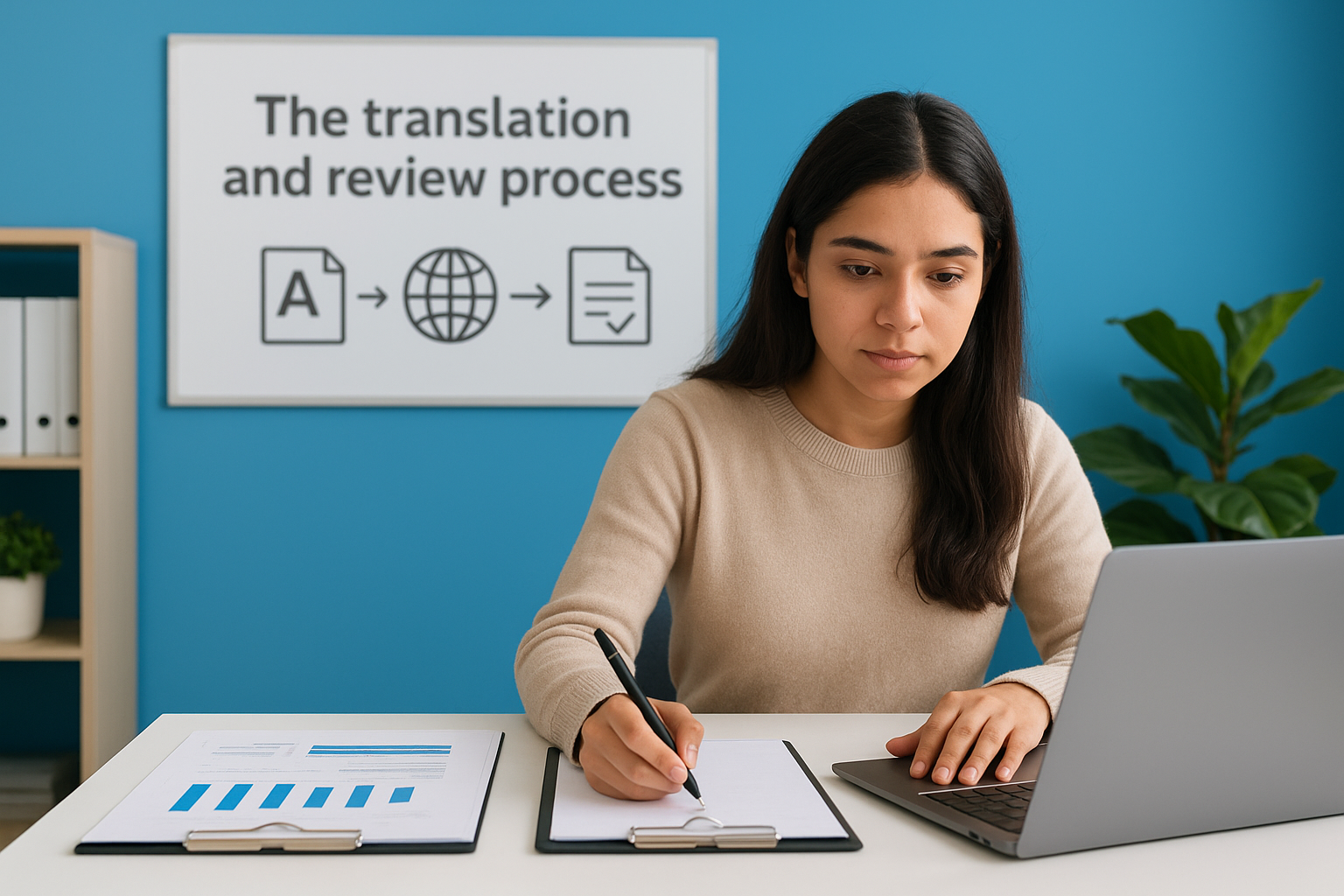
Quality advertising translation requires both linguistic precision and marketing expertise.
Who handles your campaigns
Native speakers with marketing backgrounds work on your projects, not generalist translators. You need professionals who understand conversion optimization, consumer psychology, and advertising formats in the target market. These specialists know which phrases drive action, which cultural references resonate, and how to maintain your brand’s personality while adapting to local communication styles.
What content needs transcreation vs translation
You need to know the difference between content that requires creative adaptation (transcreation) and content that benefits from direct translation. Transcreation involves rewriting your message to achieve the same emotional impact and persuasive effect in another language, while translation focuses on accurate meaning transfer. Your campaign performance depends on choosing the right approach for each content type.
Content that requires transcreation
Your creative campaign elements demand transcreation because they rely on wordplay, cultural references, emotional triggers, and brand personality. Taglines, slogans, brand names, video scripts with humor, and calls-to-action need complete reimagining to resonate with target audiences. Marketing copy that plays with language or uses idioms won’t survive direct translation without losing its punch.
Transcreation focuses on maintaining impact and emotion, not just meaning.
Content that works with standard translation
Product specifications, legal disclaimers, terms and conditions, and factual descriptions work well with standard translation because accuracy matters more than creative appeal. Your technical content, pricing information, feature lists, and compliance statements need precise meaning transfer without creative interpretation. Advertising translation services handle both approaches, but you’ll save budget by using standard translation for informational content that doesn’t drive emotional responses or purchasing decisions.
How to choose an advertising translation provider
Your provider selection directly impacts campaign performance in international markets. You need translators who understand marketing strategy, not just language conversion. Look for providers who specialize in advertising content and can demonstrate experience with campaigns similar to yours, whether that’s B2B tech marketing, consumer goods, or service-based businesses. Generic translation agencies often lack the marketing expertise your campaigns require.
Look for marketing-specific experience
Ask about their translator qualifications and whether they assign linguists with advertising backgrounds to your projects. You want professionals who understand persuasive writing, conversion optimization, and how messaging drives customer action in specific markets. Review their portfolio of completed advertising projects to see if they’ve handled content types similar to yours, such as video scripts, social media campaigns, or product launches.
Translators with marketing expertise produce better campaign results than general linguists.
Verify quality control processes
Confirm they use multi-stage review workflows that include cultural validation and marketing performance considerations. Your provider should explain how they catch issues before content goes live, who reviews translations, and what quality benchmarks they maintain. Advertising translation services that skip cultural review or rely on single-translator workflows expose your brand to costly mistakes that damage market entry efforts.
Common pitfalls that hurt performance and brand
Most companies make predictable mistakes when expanding their advertising internationally, and these errors cost real money in wasted spend and damaged reputation. You can avoid these problems by understanding where other businesses went wrong and why professional advertising translation services exist to prevent these specific failures.
Relying on automated tools for creative content
Machine translation cannot handle the nuance that advertising demands, yet many companies try it to save budget on initial market entry. Your taglines, emotional appeals, and brand personality get flattened into awkward phrases that confuse audiences or miss the mark entirely. Automated tools lack cultural context and marketing expertise, so they can’t adapt messaging for maximum impact in each market.
Machine translation might work for emails, but it kills advertising campaigns.
Skipping local market validation
You waste your advertising budget when you launch campaigns without testing them with native speakers from the target market. Cultural mistakes slip through, messaging falls flat, and competitors who validated their content capture the attention you’re fighting for. Local reviewers catch problems before they go live, from inappropriate imagery to calls-to-action that don’t motivate the target audience to convert.
A simple next step for multilingual marketing
Your international expansion doesn’t have to be complicated or risky. Start with one market and test your messaging with professional advertising translation services before rolling out campaigns across multiple regions. Choose the market with the highest potential ROI based on your product fit and existing customer inquiries, then invest in proper translation and cultural adaptation for that single region first. This focused approach lets you validate your strategy before committing larger budgets to full-scale international campaigns.
Languages Unlimited has helped businesses since 1994 navigate international markets with translation expertise across thousands of languages and dialects. Our network of marketing-focused translators understands both linguistic precision and campaign performance, so you get the cultural insights and language expertise your campaigns need to connect with international audiences and drive conversions.
Contact our team to discuss your multilingual marketing project. We’ll review your campaign materials and recommend the right approach for your target markets, whether that’s transcreation for creative content or standard translation for product information.